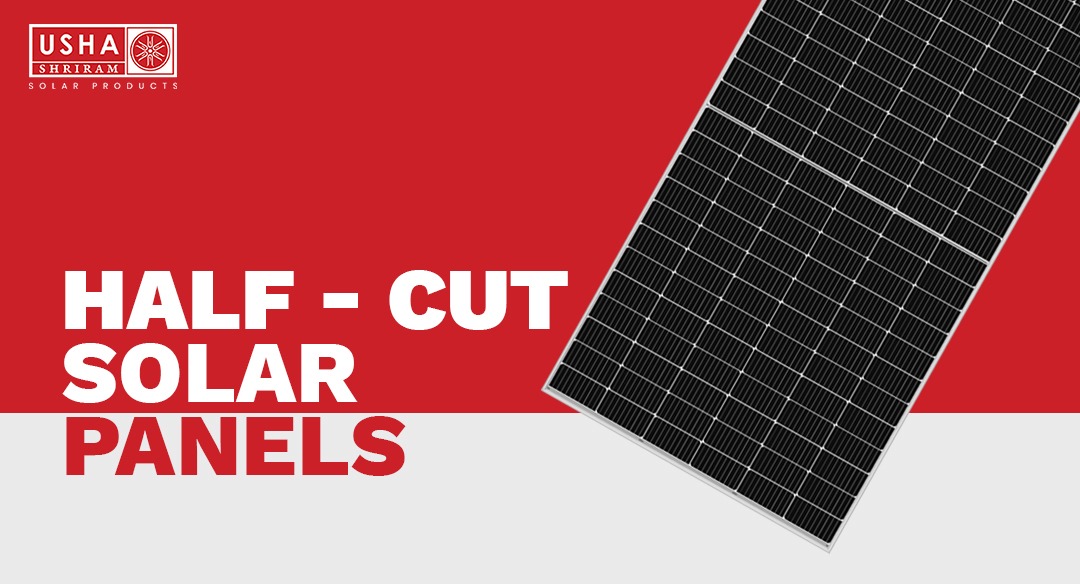
The efficiency of solar panels has come a long way in the last ten years. But one of the bigger breakthroughs that have led to this? Half-cut solar panels. They’re soon going to be the standard for home and commercial rooftop system installations in India, and for good reason.
You’re probably looking into solar installations for your home or business. You’ve probably heard about half-cut technology. But what does it really mean, and how does it matter for your specific situation?
Knowing how half-cut solar panels work can help you make more informed decisions when shopping around for solar installations. Sometimes technology is a game-changer. Sometimes it’s just hype. Here’s what you need to know.
What Are Half-Cut Solar Panels?
A typical solar panel consists of solar cells, typically 60 or 72, arranged in a grid pattern. These cells produce electricity when sunlight shines on them. That’s it.
Half-cut solar panels involve splitting these solar cells into two equal halves. This means that instead of 60 solar cells, you now have 120. Instead of 72 solar cells, you now have 144.
Why split solar cells into two equal halves? There are two reasons: improved efficiency and reliability. When you split a solar cell into two equal halves, each half will produce half the amount of electricity. This reduces the electrical resistance of the electricity as it travels through the solar panel. Reduced resistance translates to reduced energy losses in the form of heat.
The second advantage is redundancy. Conventional solar panels connect all the cells in series. If a cell is shaded or damaged, the whole string is affected. Half-Cut Technology rearranges the connections. The solar panel is divided into two separate units. Shading one unit will not affect the whole solar panel.
This is important in practical applications. Tree shadows. Buildings in the vicinity. Antennas and pipes on top of buildings. Things that shade small areas of solar panels do not affect them as much in half-cut technology
How Half-Cut Solar Panels Actually Work?
The physics of a solar cell remains the same whether it is a full cell or it is divided in half. The photons from the sun loose the electrons in the silicon material, producing electric current. This remains the same.
The difference lies in the circuitry design of the solar panel. Conventional solar panels connect all the cells in a string. Half-cut solar panels, on the other hand, are divided into two parts, each with a substring. This is where the benefit of half-cut technology comes into play.
1. Less Current, Less Loss – When electric current passes through a solar cell, some of the energy is lost as heat due to resistance. The amount of lost energy is proportional to the square of the current. If you cut the current in half, the heat losses will be reduced to a quarter. This is energy that you can actually use, as opposed to heat that is of no use.
2. Better Shade Tolerance – In conventional panels, if one cell is shaded, it can decrease the production of 18-20 cells in the same row because of how bypass diodes function. In half-cut panels, the effect of shading is on smaller groups. It affects fewer cells in the same row. Your panels continue to produce more power even when partially shaded.
3. Less Hot Spot – Hot spots occur when a cell is not able to perform as well as other cells in the string, which is usually due to either shading or defects in the cell. The cell gets hotter. Since the current is lower in half-cut panels, hot spots are not as severe.
The design of the panel has three junction boxes instead of one (two in some models). This enables the separate sections to function independently. If the top half is shaded, the bottom half continues to produce maximum power.
Best Types of Half-Cut Solar Panels
Half-Cut Technology is applicable to varioussolar cell technologies. The three primary types you can expect:
1. Monocrystalline Half-Cut Panels – These solar panels consist of single-crystal silicon solar cells, which are further divided into two half-cut panels. These panels are the most efficient, with efficiencies of 20-22% and above. The solar cells are of a uniform dark blue or black color. Monocrystalline half-cut panels are the most commonly used solar panels in Indian residential and commercial rooftop systems because they produce more power per square meter, which is essential when roof space is a concern.
2. Polycrystalline Half-Cut Panels – These solar panels are composed of multiple silicon crystals. These panels are less efficient (17-19% efficiency) but cost way less. The solar cells have a blue color with a grain pattern. These solar panels are less in use today because of the reduction in the cost of monocrystalline solar panels.
3. Bifacial Half-Cut Panels – These panels can harness sunlight from both the front and rear sides of the panel. The rear side of the panel can harness the sunlight that is reflected from the ground or roof surface below. When combined with half-cut cells, bifacial panels can increase overall energy production by 10-30%, depending on the installation conditions. These panels are best suited for installations on white or reflective roofs.
For most Indian households and commercial establishments, monocrystalline half-cut panels would be the most optimal choice.
Half-Cut vs Full-Cell Solar Panels: What’s the Difference?
Comparing half-cut solar panels to the more conventional full-cell solar panels, here are the key differences:
| Feature | Half-Cut Solar Panels | Full-Cell Solar Panels |
| Efficiency | 2–5% higher efficiency due to lower resistive losses | Slightly lower efficiency due to higher internal resistance |
| Extra Output (5 kW system) | 100–250W additional generation over time | Standard output |
| Temperature Performance | Better heat dissipation; performs slightly better in high temperatures | Slightly more efficiency drop in extreme heat |
| Shading Performance | 20–25% loss under partial shading | 40–50% loss under similar shading conditions |
| Internal Design | Divided into two sections (dual substring design) | Single continuous string design |
| Hot Spot Risk | Reduced due to lower current | Higher risk under shading or mismatch |
| Durability | Comparable reliability when manufactured to high standards | Proven durability; similar long-term reliability |
| Cost | 5–10% higher (often negligible today) | Slightly lower upfront cost |
| Appearance | More visible cell lines due to split design | Cleaner visual look |
| Best For | Rooftops with partial shading, high-temperature regions | Budget-focused installations with minimal shading |
Benefits of Half-Cut Solar Panels
Why are half-cut solar panels becoming the norm for commercial rooftop systems and residential solar power installations?
1. Higher Energy Output – The efficiency boost of 2-5% translates to more electricity being produced from the same area of the roof. Over 25 years, this translates to significant additional electricity production and cost savings on electricity bills.
2. Better Performance in Real Conditions – Laboratory tests simulate ideal conditions. Real-world roofs are not ideal, with shading, dust, and temperature variations. Half-cut solar panels perform better in real-world conditions than conventional solar panels.
3. Less Hot Spot Problems – Hot spots can cause damage to solar panels over time, resulting in panel failures. The reduced current in half-cut solar panels mitigates hot spot problems, potentially increasing the lifespan of solar panels.
4. Better Shade Tolerance – Indian roofs are often partially shaded by water tanks, TV antennas, and trees in the neighborhood. The effect of shade on your solar array is significantly reduced by half-cut technology.
5. Smaller Temperature Coefficient – As solar panels heat up, their efficiency decreases. Half-cut panels are slightly less affected by the temperature coefficient. In the Indian climate, this advantage is experienced every afternoon when the sun beats down on your solar panels.
6. Established Reliability – Half-Cut Technology is not a new concept. It has been in mass production for several years now, and its performance has been consistent with what is promised. It has been adopted by leading solar manufacturers across the globe.
For residential and commercial consumers considering solar power, these advantages mean that you will get a better return on investment. You will pay a premium for solar panels that give you a higher return on investment.
Why Choose Usha Shriram Solar?
Usha Shriram Solar brings years of experience in the solar industry, backed by a strong focus on manufacturing quality that truly matters for long-term performance. When you invest in solar, you are committing to a system that should perform reliably for 25 years or more. Usha Shriram Solar produces panels built to international quality benchmarks, ensuring consistent efficiency, durability, and performance across varying environmental conditions.
With a strong presence across India, supported by distribution and service networks, the company ensures that customers receive not just installation support but long-term reliability and assistance whenever needed. Installing solar panels is only the beginning, real value lies in sustained performance and dependable service support over the years.
Usha Shriram Solar continues to adopt the latest advancements in solar technology, including advanced half-cut solar panel designs. The company currently manufactures high-efficiency half-cut solar panels in the 550W to 585W range, designed to deliver better energy output, improved shade tolerance, and enhanced temperature performance that is especially suited for Indian rooftop conditions.
These modules are not experimental; they are built on proven, globally accepted technology and tested for performance in India’s extreme heat, humidity, and dust-heavy environments. For homeowners and businesses considering half-cut solar technology, partnering with a trusted manufacturer like Usha Shriram Solar helps reduce long-term risk and ensures that the system continues to deliver strong returns well beyond installation.
Making the Decision
Half-cut solar panels are a real step forward in solar technology. The efficiency improvements are tangible. The shade tolerance is useful in real-world applications. The reliability advantages are important too.
In most solar power applications in India, whether it is residential or commercial, half-cut solar technology is a good choice. The marginal increase in cost is offset by improved energy output in the long run.
The important thing is to partner with good manufacturers who do the job right. Sub-standard half-cut solar panels are no better than sub-standard traditional solar panels. Good manufacturing practices are more important than the technology used in cutting solar cells.
Usha Shriram Solar offers the best of half-cut solar technology, good manufacturing practices, and comprehensive support. For solar power applications that must last for many decades, this is a winning combination that will give you results you can rely on.
