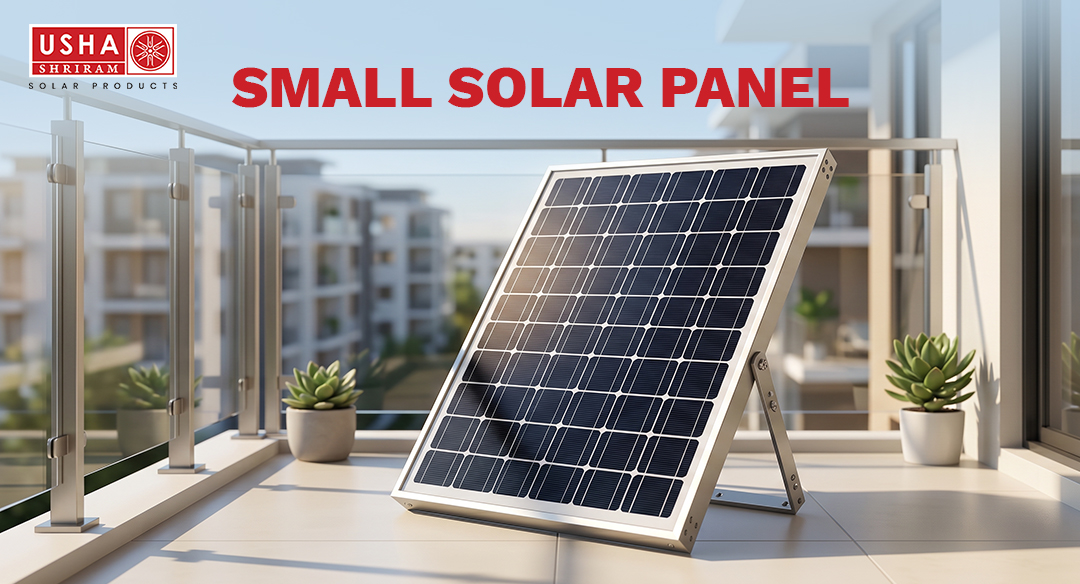
Often small solar panels are seen as the same thing — both are small, they can be used away from the main grid, and they generally show up together when searching. However these two types of solar panels serve different purposes and if you purchase the wrong one you might end up buying too much solar power or not enough for your needs.
Interest in small solar panel options is on the rise in India — from students who want to build solar-powered devices for their engineering projects to homeowners looking to purchase backup power for specific appliances. Now more than ever before, there are many options available, with prices lower than ever seen before. This article will give you detailed explanations of what small and portable solar panels are all about, what they cost, and which option would work best for you.
What Are Small Solar Panels?
Small solar panels are low-wattage fixed and/or semi-fixed photovoltaic (PV) modules, typically generating between 5 and 100 watts of energy. Small format solar panels are well suited for use in applications where a consistent amount of solar power is required at a designated area.
They are used for charging small batteries and power banks, LED lighting systems, powering sensors, garden lights, or water pumps, student and engineering projects, and rural electrification for specific loads.
They are not intended to power an entire home. But for targeted, low-energy applications — they are reliable, durable, and cost-effective. Small solar modules typically use mono- or polycrystalline cells. Mono-crystalline cells offer higher efficiency in limited space; polycrystalline cells cost less relative to physical size.
Small Solar Panel Price in India (2026)
Small solar panel price in India varies mainly by wattage, cell type, and brand. Here’s a rough market overview:
- 5W – 10W panels: ₹500 – ₹1,500. Suitable for garden lights, small sensors, or basic project work.
- 20W – 40W panels: ₹1,500 – ₹3,500. Works for charging batteries, running a few LED lights, or powering small fans.
- 50W – 100W panels: ₹3,000 – ₹8,000. Handles more substantial loads — a DC fan, a small pump, or a basic home lighting circuit.
For portable panels, the price range climbs faster. A decent 100W foldable unit typically starts around ₹8,000 and can go well beyond ₹20,000 for branded options with higher efficiency ratings.
Brands like Usha Shriram offer solar PV modules built for Indian weather conditions — designed to perform reliably through heat, dust, and seasonal variation. If you’re buying for a fixed installation rather than travel use, a quality rigid panel from a trusted brand is almost always the better long-term value.
How Much Is a Small Solar Panel?
One common question buyers ask is, “How much is a small solar panel?”
The answer depends on the panels capacity and intended use.
Here is an estimated price range for solar panels:
Panel Capacity:
5 Watt: ₹400 – ₹700
+ 10 Watt: ₹700 – ₹1,200
+ 20 Watt: ₹1,200 – ₹2,000
+ 40 Watt: ₹2,000 – ₹3,500
+ 50 Watt: ₹2,800 – ₹4,500
+ 100 Watt: ₹5,000 – ₹8,000
Prices are indicative and may vary depending on the brand, technology and market conditions of small solar panels.
When comparing prices do not focus on cost. Check the panels efficiency, warranty, durability and certifications to get the value for your investment in small solar panels.
Types of Small Solar Panels
Not all solar panel small size options are built the same way. Understanding which type of solar panel to buy can save a significant amount of money.
Monocrystalline panels: are manufactured from one silicon crystal, and therefore provide a higher level of efficiency per square centimeter than other types of solar panels. Because they are more efficient than polycrystalline panels, a monocrystalline panel will produce more energy than a polycrystalline panel for the same clearance area on its roof, but will cost slightly more.
Polycrystalline panels: consist of many small pieces of silicon that are pressed together. As such, they generate low to moderate energy output, but are generally less expensive than monocrystalline panels. For most small solar panel for project, polycrystalline panels sufficient.
Thin-film or amorphous solar panels: can be bent or are flexible and lightweight. They generate less energy than other types of solar panels but are designed to work in low levels of natural and indirect sunlight. They are not readily available in the Indian market, except for use in small, specialty applications.
For most buyers in India – students, people living in rural areas, and people using a simple solar-powered device – either a monocrystalline or polycrystalline solar panel will provide ample power.
Before making a purchase consider the following factors for solar panels:
1. Solar Panel Technology
Monocrystalline solar panels offer efficiency and better performance in low-light conditions. They are suitable for installation space with small solar panels.
2. Power Requirement
Estimate your electricity consumption to determine the appropriate small solar panel size.
Buying a panel thats too small may not meet your energy needs.
3. Build Quality
Choose weather- panels with tempered glass and corrosion-resistant aluminum frames for better durability in small solar panels.
4. Warranty
A quality small solar panel should include a product warranty and a performance warranty for long-term reliability.
5. Certifications
Always select panels from trusted manufacturers that comply with BIS and MNRE standards for solar panels.
Purchasing from a manufacturer like Usha Solar ensures quality, efficiency and dependable after-sales support for small solar panels.
Small Solar Panel Sizes and Their Applications
A small solar panel size is perfect for applications where compact dimensions and lightweight installation are required for solar panels.
Popular uses include:
-Solar garden lights
-Mobile phone charging
-CCTV camera backup
-Street lighting
-Solar lanterns
-Battery charging systems
-Water pumps for farms
-IoT devices
-Educational and DIY projects
-Emergency power backup
These compact panels are easy to transport, install and maintain. They are a choice for both residential and commercial applications with small solar panels.
Best Use Cases for Small Solar Panels
If you need a renewable power source to keep something powered consistently (in or around the house, at the farm, or on rural farms), go with small fixed panels. Once you’ve got them correctly mounted and oriented, their output is on average much more predictable from day to day than portable solutions.
A large majority of people that purchase small fixed solar panels are engineering/science students. These students typically use them as energy generation demonstrations, powering sensor circuits, or running small DC motors — making it ideal for a small solar panel for project submissions or lab work.
Other common uses for small fixed panels (like garden lights, water pumps, and remote sensors) are also usually low-maintenance. Once these panels are correctly installed, you can almost ignore them. No folding of the panel, reorienting the panel, or worrying about whether the panel is mounted on a level surface.
How to Choose the Right Small Solar Panel?
There’s no universal answer here. It depends on what you’re actually trying to power.
Start with your load. Add up the wattage of everything you want to run and how many hours per day you need it. That tells you the minimum panel size. Add 20–30% buffer for cloudy days and transmission losses.
Then look at your space. Monocrystalline panels are the right call when you have limited roof or mounting area and need to squeeze more output from a smaller footprint. If space isn’t a constraint, polycrystalline panels get you similar results for less money.
Brand matters more than most buyers expect. A no-name panel rated at 50W may only deliver 35–40W in real conditions. Panels from established brands — ones that publish actual test data and carry warranties — perform closer to their rated output over the long run.
Finally, think about your budget across the product’s lifetime, not just the purchase price. A cheap solar panel small size option that degrades fast or has no after-sales support will cost more to replace than a decent panel bought once.
Pros & Cons
Small Solar Panels
Pros: Long lifespan — most quality panels carry 10–25 year performance warranties. Cost-effective per watt, especially compared to portable alternatives. Once installed, maintenance is minimal — no moving parts, no regular servicing needed. Output is consistent and predictable when the panel is properly mounted. Indian-market brands are built to handle heat, dust, and monsoon conditions without performance loss.
Cons: Not portable — once mounted, they stay where they are. Requires proper installation with the right angle and orientation; a badly mounted panel loses significant output. Performance depends on location. Panels in high-shade areas or with frequent dust buildup will underperform their rated capacity without occasional cleaning.
Conclusion
Rigid and portable solar PV modules are designed for different applications — they can’t really compete with each other. Once you know what your specific needs are, the right type of panel is typically clear.
If you plan to install a fixed solar electricity generation system at home, in an unoccupied area, or as part of a project, rigid panels are typically going to be the better value because of their long life and durability. But when you need to generate electricity while moving around, portable solar panels are the better choice.
Usha Shriram has been providing high-quality solar solutions to the Indian market for many years. Their products are engineered for the local climate and conditions. Explore their solar range at usha.in/solar-panels.
