Introduction
Modern homes are using more electricity than ever, with appliances such as air conditioners, refrigerators, washing machines and water heaters becoming part of everyday life. As electricity requirements grow, many homeowners are exploring ways to generate a portion of their own power. Rooftop solar panels offer a practical way to use available roof space to convert sunlight into electricity.
A rooftop solar system is made up of several components, with solar photovoltaic (PV) modules playing a central role. These modules capture sunlight and convert it into direct current (DC) electricity. When selected and installed as part of a suitably designed system, they can help households reduce their dependence on grid-supplied electricity.
Usha Shriram Solar is a solar PV module manufacturer serving the growing demand for solar energy across residential, commercial and industrial applications. This guide explains how rooftop solar panels work, what homeowners should consider before choosing them, and why module quality matters.
What Are Rooftop Solar Panels?
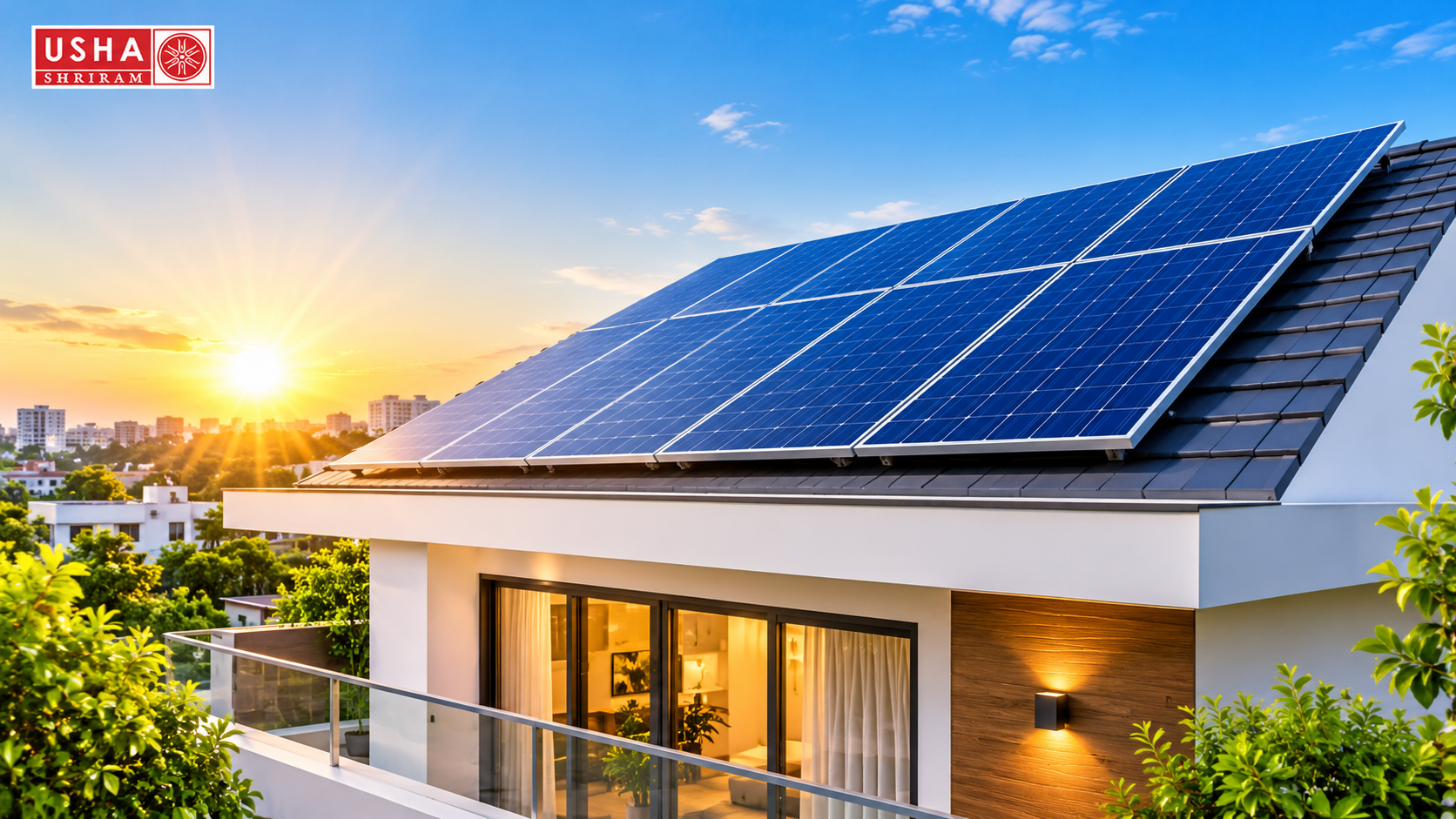
Rooftop solar panels are photovoltaic modules installed on a suitable roof to generate electricity from sunlight. The modules contain solar cells that convert sunlight into DC electricity. In a typical on-grid residential system, an inverter converts this electricity into alternating current (AC), which can be used by household appliances.
A rooftop solar system generally includes solar PV modules, an inverter, mounting structures, electrical protection devices and connecting cables. The exact configuration depends on the property’s electricity requirements, roof conditions and applicable grid-connection rules.
Standard rooftop solar panels are mounted above an existing roof using suitable mounting structures. They are different from building-integrated photovoltaic (BIPV) products, which are designed to form part of a building’s roof or façade. Homeowners should check the product specification carefully and choose a solution that matches the actual project requirement.
Why Are Homeowners Considering Rooftop Solar?
One of the main reasons homeowners consider rooftop solar is the opportunity to generate electricity at the point of use. Electricity generated during daylight hours can be used to operate suitable household appliances, helping reduce the amount of electricity drawn from the grid at those times.
The financial benefit depends on several factors, including the system’s capacity, household consumption pattern, sunlight availability, electricity tariff and the rules for exporting surplus electricity. Solar should therefore be considered as a long-term energy investment rather than a fixed or guaranteed amount of monthly savings.
Rooftop solar can also make productive use of roof space that may otherwise remain unused. For homeowners planning a new property or upgrading an existing one, considering solar early can help with decisions about roof layout, access and electrical provisions.
How Does an On-Grid Rooftop Solar System Work?
In an on-grid solar system, PV modules generate DC electricity when sunlight falls on their solar cells. The inverter converts the DC output into AC electricity for use in the home. The system operates in coordination with the local electricity grid, subject to the applicable utility and regulatory requirements.
When the home uses electricity while the solar system is generating power, the generated electricity can help meet that demand. Depending on local regulations and the approved net-metering or other export arrangement, surplus electricity may be supplied to the grid. Electricity can be drawn from the grid when solar generation is insufficient, such as at night.
A typical on-grid system does not provide backup power during a grid outage unless it includes specifically designed backup equipment. Homeowners should discuss system functionality and safety requirements with a qualified installer before making a decision.
Planning Rooftop Solar for a New Home
If a home is still at the planning or construction stage, solar requirements can be considered early. The architect, structural professional and solar installation partner can review the available roof area, orientation, potential shading, access routes and space for electrical equipment.
Planning ahead may make it easier to provide suitable cable routes and avoid placing rooftop equipment where it could obstruct solar modules or maintenance access. It also gives homeowners an opportunity to consider their expected electricity consumption and future requirements, such as additional air conditioning.
The solar modules should be selected according to the project’s technical requirements, available space and compatibility with the rest of the system. A qualified solar professional should assess the site and determine the appropriate system design.
Can Existing Homes Install Rooftop Solar?
Existing homes may also be suitable for rooftop solar, provided the roof and electrical arrangements meet the relevant requirements. Before installation, the roof should be assessed for structural condition, usable area, shading, orientation and access for inspection and cleaning.
If significant roof repairs are required, homeowners may wish to complete them before a solar system is installed. Solar modules and mounting structures are intended for long-term use, so the roof should be in an appropriate condition for the proposed installation.
The system size should be considered alongside the household’s electricity consumption and the roof’s usable area. Simply fitting the maximum possible number of modules is not always the best approach; the system should be planned around the property’s actual needs.
Why Roof Orientation, Shade and Sunlight Matter
Solar modules need sunlight to generate electricity, but the amount of energy produced varies with site conditions. Trees, nearby buildings, water tanks, parapet walls and other obstructions can cast shadows on a roof and affect system output.
Roof orientation and tilt also influence how much sunlight the modules receive during the day and across different seasons. The total roof area alone does not determine how many modules can be used effectively. Access paths, safety clearances and shaded areas may reduce the usable space.
A qualified installation professional can assess these factors and estimate the expected system performance for the specific property. Homeowners should ask what assumptions have been used in any generation estimate.
Choosing the Right Solar Panels for Your Home
Solar modules are a key part of a rooftop solar system. When comparing products, homeowners should look beyond the headline wattage or purchase price and review the technical information and warranty documents.
Important factors to compare
- Rated power output: Check the module’s stated wattage and compare products under the same test conditions.
- Module efficiency: Efficiency indicates how effectively a module converts sunlight into electricity and can be relevant where roof space is limited.
- Cell and module technology: Understand the technology used and review the manufacturer’s published product specifications.
- Product quality and certifications: Check applicable standards, certifications and product documentation for the model being considered.
- Warranty: Read the product warranty and performance warranty carefully, including the applicable terms and exclusions.
- System compatibility: Confirm that the module is compatible with the inverter, mounting arrangement and other system components.
Usha Shriram Solar manufactures solar PV modules for residential, commercial and industrial applications. Homeowners and project partners should refer to the latest product catalogue and technical datasheets to confirm the specifications, technology and warranty applicable to a particular module.
Understanding Solar Panel Technology
Solar module technology continues to develop, with manufacturers working to improve power output, efficiency and overall product performance. TOPCon is one of the advanced solar cell technologies used in today’s PV market. The right module depends on the project requirements and the specifications of the available product.
Bifacial modules are designed to receive light on both the front and rear sides. The additional energy yield, if any, depends on factors such as the reflective properties of the surface below the modules, mounting height, spacing and site conditions. Actual performance should be assessed for the specific installation rather than assumed from the technology name alone.
When evaluating a module, homeowners and installers should compare verified datasheets and warranty terms instead of relying only on broad technology claims.
How Much Can Rooftop Solar Save?
The savings from a rooftop solar system vary from one home to another. Important factors include system capacity, the household’s daytime electricity use, local sunlight conditions, electricity tariffs, system performance and the rules governing electricity export.
A home that uses a significant amount of electricity during daylight hours may be able to consume more of the solar electricity as it is generated. Another home may export a larger share of its surplus generation, depending on its usage pattern and the local grid arrangement.
Homeowners should request an estimate based on their actual electricity bills, roof conditions and applicable utility rules. Any estimate should clearly state its assumptions and should not be treated as a guaranteed saving.
Government Support and Rooftop Solar in India
Government programmes and state-level policies can influence the cost and adoption of residential rooftop solar. In India, the PM Surya Ghar: Muft Bijli Yojana is a major residential rooftop solar initiative. Eligibility, subsidy amounts, approved equipment requirements and application procedures are governed by the latest official guidelines.
Scheme details may change, and eligibility can depend on the consumer, system and installation arrangements. Homeowners should consult the official government portal and relevant electricity distribution company for current information before making a purchase decision. They should also confirm that the proposed system and installation process meet the applicable requirements.
Maintenance of Rooftop Solar Panels
Solar PV modules generally require limited routine maintenance, but their performance can be affected by dust, leaves, bird droppings and other debris. Cleaning frequency depends on local conditions, rainfall, dust levels and the manufacturer’s guidance. Cleaning should be carried out safely and in accordance with the installer’s recommendations.
The overall solar system should also be checked periodically. This may include monitoring system output and having the inverter, wiring, mounting structures and electrical protection equipment inspected by a qualified professional. Any unusual reduction in generation should be investigated rather than assumed to be a panel issue.
Why the Solar Module Manufacturer Matters
Solar modules are expected to operate outdoors for many years. Choosing a manufacturer with clear product documentation, traceable specifications and defined warranty terms is therefore an important part of the purchasing decision.
Homeowners and solar project partners should review the manufacturer’s product datasheets, applicable certifications, warranty documents and support process. They should also ensure that the module model supplied matches the model specified for the project.
As a solar PV module manufacturer, Usha Shriram Solar supports the solar value chain through its module portfolio and dealer and distributor network. For the latest information about available module models, technology and specifications, refer to the company’s official product information or contact an authorised channel partner.
Frequently Asked Questions
What are rooftop solar panels?
Rooftop solar panels are photovoltaic modules installed on a building’s roof to convert sunlight into electricity. They are used as part of residential, commercial and industrial solar power systems.
Which solar panels are suitable for a modern home?
The suitable module depends on roof space, electricity requirements, system capacity, budget and compatibility with the inverter and other components. Compare rated power, efficiency, technology, product documentation and warranty before selecting a module.
How does an on-grid rooftop solar system work?
Solar modules generate DC electricity, and an inverter converts it into AC electricity for household use. The system works in coordination with the electricity grid, and surplus electricity may be exported where permitted by local regulations and the approved connection arrangement.
Do solar panels generate electricity on cloudy days?
Solar modules can generate electricity in cloudy conditions, but output is generally lower than under strong sunlight. The amount depends on cloud cover, module characteristics and site conditions.
What is TOPCon solar technology?
TOPCon stands for Tunnel Oxide Passivated Contact. It is a solar cell technology used in photovoltaic modules. Buyers should review the specific module datasheet to understand its rated power, efficiency and other performance characteristics.
How long do solar panels last?
The expected service life and warranty coverage depend on the product and manufacturer. Buyers should review the applicable product warranty and performance warranty documents for the exact module model.
Do rooftop solar panels need regular cleaning?
Dust and debris can reduce the sunlight reaching the modules. Cleaning requirements depend on local conditions and should follow the manufacturer’s and installer’s safety recommendations.
Explore Solar Modules from Usha Shriram Solar
Choosing suitable solar modules is an important step in planning a rooftop solar system. Consider the roof, electricity requirements, module specifications and applicable grid rules, and work with a qualified installation professional for system design and installation.
Usha Shriram Solar manufactures solar PV modules for residential, commercial and industrial applications. Explore the company’s product range and connect with an authorised dealer or distributor for product information and enquiries.
