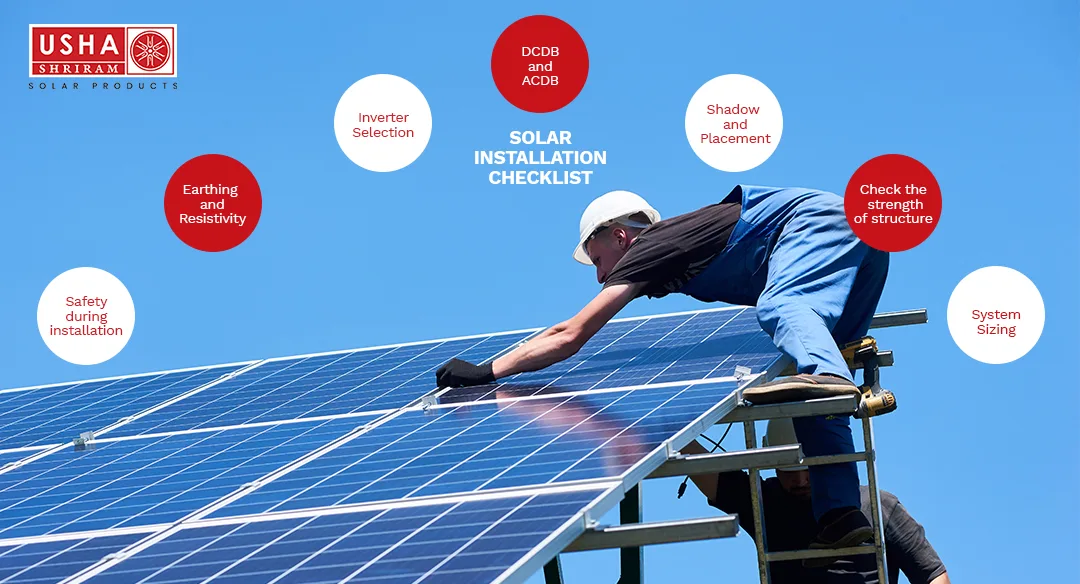
You’ve chosen to go solar. Congratulations – your roof is soon going to start paying for itself. But here’s a tiny secret about solar energy that most people learn a little too late in life: A high-quality solar panel with low standard solar installation will perform worse than an average solar panel with quality solar installation. Yes. That’s how important solar installation is.
Solar panel installation is not just a matter of “fit the panels and turn them on.” There is a proper solar installation guide because taking tiny shortcuts in solar panel installation can lead to costly surprises down the line. So before your rooftop solar system installation process even begins, here’s a simple, slightly humorous checklist to ensure everything goes smoothly, safely, and shock-free. Let’s begin.
Before You Install Solar: 8 Things You Must Get Right
1. Check the Strength of Structure – Since Panels Need a Strong Foundation
Your solar panels will be installed on your roof for 25 years. This means that the structure supporting your solar panels cannot be of “chalega” quality. Consider this: Would you place a heavy water tank on a weak stand? No. A good solar panel installation requires that the structure supporting the panels has:
• Appropriate thickness (2mm, 3mm, 5mm depending on the wind zone)
• Hot dip galvanization (to protect against rust)
• Use of stainless steel screws (SS-304 is preferred)
• Appropriate tilt and row spacing
But what exactly is “hot dip galvanization”? It is the application of a thick layer of zinc to the metal structure to make it rust-resistant. Not just painted, mind you. Properly coated. Because if the structure rusts, your solar panels won’t just fall off – but they will weaken over time.
And India has different wind zones. Solar panels are like sails, if your structure is not supported properly they can easily catch the wind.
Read More – Can Solar Run AC, Lift, Motors & Heavy Machines?
2. Earthing & Resistivity – The Safety Net You Can’t See
Earthing is a very dull term. Until lightning strikes. In layman’s terms, earthing provides a safe path for electricity to escape. When there’s a fault or surge, the excess current goes into the earth, not your inverter. A good solar power system should have the following earthing:
• Separate earthing for DC side (panels)
• Separate earthing for AC side (output)
• Separate earthing for lightning arrestor
• Soil resistivity testing
But what exactly is soil resistivity? It’s a measure of your soil’s ability to absorb electric current. If your soil doesn’t conduct well, earthing won’t be effective.
Let’s break it down like this: Water poured into concrete won’t be absorbed. Water poured into loose soil will be absorbed immediately. It’s the same with this. Without earthing, one surge will ruin:
• Your inverter
• Panels
• Cables
• And your savings
Earthing is not that impressive. But it protects everything.
3. DCDB & ACDB – The Silent Bodyguards of Your System
Now, let’s discuss two things that most homeowners hear during the installation process and forget quickly after: DCDB and ACDB. They have complicated-sounding names, but they’re not.
DCDB (Direct Current Distribution Box) deals with the power coming from your solar panels. ACDB (Alternating Current Distribution Box) deals with the power going to your home or the grid. They’re like traffic cops. Solar panels produce electricity. The inverter converts it. But DCDB and ACDB regulate and safeguard it.
In a good solar panel installation manual, you need to check these things:
• DCDB and ACDB are separate
• IP65 rating (which means it’s dust and water-resistant)
• Proper MCB/MCCB breakers
• Surge Protection Device (SPD)
• Lightning arrestor (if necessary)
• Copper busbars for correct current flow
But what is a Surge Protection Device (SPD)?
SPD safeguards your system from voltage spikes. When the grid has voltage fluctuations or a lightning strike occurs in the area, the SPD takes the hit before it reaches your inverter. Without it, your inverter takes the hit. And let me tell you, inverters are costly shock absorbers.
Learn More – Solar Panel Made in India
4. Wires – The Part Everyone Ignores (Until Something Goes Wrong)
Solar cables are not very impressive to look at. But they are the ones that determine how much power will actually reach your home. In most cases of substandard solar power installations, power losses occur not because of the solar panels, but because of poor wiring.
A good solar power system should have:
• XLPE insulated solar cables
• UV-resistant wires (exposure to sunlight will damage low-quality wires)
• Appropriate DC voltage rating (660/1000V or higher)
• Appropriate routing within RPVC pipes or GI trays
• Labeling and tagging
Now, let’s break this down for you. If you produce 10 units of power but lose 1 unit because of poor wiring, that’s 10% gone – silently. With poor wiring, you won’t see any smoke. You won’t hear any alarms. You’ll just have slightly lower savings. And that’s the scary part.
5. Inverter Selection – The Brain of Your Solar System
While solar panels are the heart, the inverter is the brain. Solar panels produce DC power. Your home consumes AC power. The inverter bridges the gap by converting DC power to AC power. An incorrect inverter selection may result in:
• Power losses
• Frequent shutdowns
• Low efficiency
• Poor monitoring
Before solar panel installation, you need to check:
• Capacity according to your system size
• Efficiency of 97% or higher (for larger systems)
• Correct grid synchronization
• Monitoring facility available
• Compatibility with single-phase or three-phase systems
Now, let’s explain the above statement in detail. If your home connection is single-phase and you have a three-phase inverter, it won’t work properly. It’s like purchasing a three-pin plug for a two-pin socket. It won’t fit. New inverters also enable monitoring through mobile apps. You can track daily production, monthly savings, and performance on your mobile. These features keep you in control.
Read More – TOPCon Solar Panel with Advanced N-Type Technology
6. System Sizing – Bigger Is Not Always Better
When it comes to system sizing, many homeowners consider: “Let’s install the largest system possible.” That’s not always the best idea.
The right solar installation should have:
• Load analysis
• Analysis of monthly electricity bills
• Check on sanctioned load
• Future appliances
If you install a system that is too large, you may run into limitations on net metering, and also may export power without reaping the proper benefits. If you install a system that is too small, you may cut down on savings and your payback period will increase. That’s why proper sizing will give you faster ROI.
7. Shadow & Placement – Sunlight Has Rules
Solar panels require direct sunlight. Even partial shading can significantly affect the output. Before installing solar panels:
• Conduct shadow analysis
• Check spacing between rows
• Confirm proper tilt angle
• Prefer south-facing orientation (where possible)
Now, let’s discuss why shadow analysis is important-
Solar panels are wired in series. If one panel in a string gets shaded, the entire string’s output drops. The shadow of a single water tank can affect the output of several solar panels. That’s why a good solar panel installation on the rooftop should take into account the shadows for the whole year, not just the day of installation. Sunlight is free, but shadows are costly.
Learn More – State Wise Solar Subsidies in India for a Greener Future
8. Safety During Installation – Because Carelessness Costs
During solar system installation, ensure that:
• Installation is not done during rainy conditions
• Panels are not walked on directly
• Safety harness is used correctly
• Electrical connections are properly secured
Walking on panels creates micro-cracks. Micro-cracks decrease lifespan. Decreased lifespan decreases ROI. Solar panels are robust – but they are not to be walked on. A good installation today prevents repair tomorrow.
Final Check Before You Say Yes
Before approving your solar installation, ask:
• Is the structure hot dip galvanized?
• What is the structure thickness?
• Are DC and AC earthing separate?
• Is soil resistivity tested?
• Are DCDB and ACDB properly installed?
• Is SPD included?
• Are cables certified and UV resistant?
• Is inverter capacity correct?
• Single-phase or three-phase confirmed?
• Shadow analysis done?
If the installer answers confidently — you’re in safe hands.
Conclusion
Solar panels can last 25 years. But only if the solar installation is done correctly. Most performance issues don’t come from panels. They come from shortcuts — weak structure, poor earthing, missing SPD, cheap wires, wrong inverter configuration.
A structured solar installation ensures:
- Safety
- Stable generation
- Faster ROI
- Long-term reliability
At Usha Shriram Solar, installations follow proper technical guidelines because solar is not just about producing electricity — it’s about protecting your investment.
If you’re planning rooftop solar system installations, make sure the installation is as strong as the sunlight.
How many earthing points are needed in a rooftop solar installation?
A good solar installation requires separate earthing for DC, AC, and lightning protection.
What will happen if the SPD (Surge Protection Device) is not installed?
If the SPD is not installed, then the voltage surge due to lightning or grid fluctuations may damage your inverter.
Can I install a three-phase inverter on a single-phase connection?
No, because the inverter type should be the same as your electrical connection; otherwise, the solar installation will not work properly.
Does shadow affect solar panel performance that much?
Yes, because even a small shadow may affect the overall generation.
