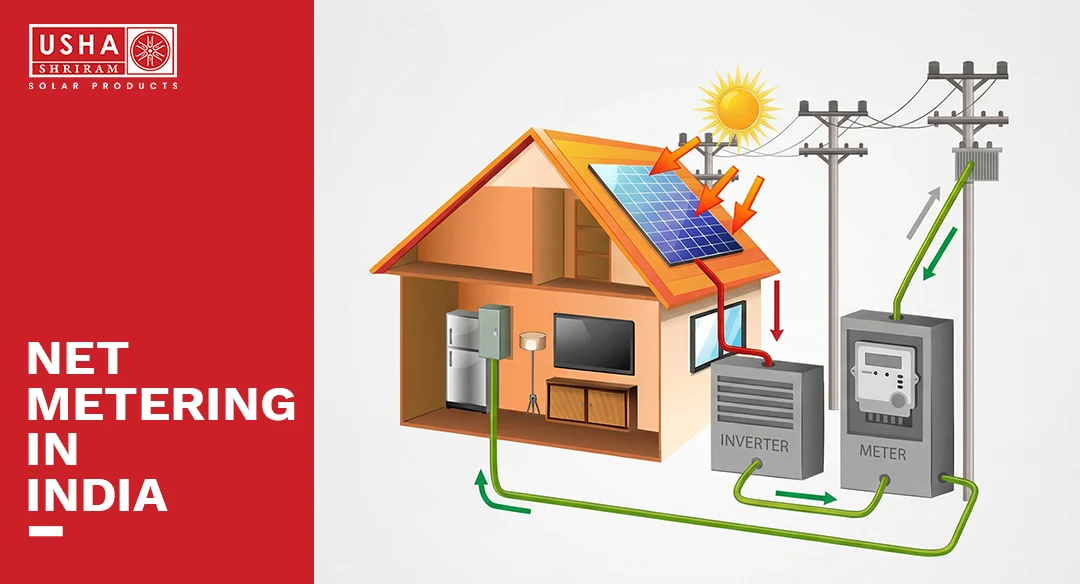
Imagine your electricity meter running backwards. Sounds strange? That’s exactly what happens with net metering.
Here’s how it works in a real household. You have installed solar panels at your home. The system generates 350 units per month, and your family consumes only 280 units. The extra 70 units generated by your solar panels don’t go to waste, they are sent to the grid. The electricity company then credits your account, reducing your next bill to almost zero.
That’s the benefit of having net metering installed at your home. With net metering, you not only save on electricity bills but can also earn from excess solar generation.
This guide explains everything about net metering in India, covering how it works, its benefits, the application process, and policies across different Indian states.
What is Net Metering?
Net metering in India is a billing mechanism that allows solar panel owners to send excess electricity back to the grid and receive credits against future electricity consumption.
To understand it easily, think of it like a bank. During sunny afternoons, your solar panels generate more electricity than you use, so the extra power gets “deposited” into the grid. At night, or when sunlight is low, you generate less electricity and “withdraw” power from the grid. Your electricity meter tracks both and calculates the final bill based on the difference.
Here, net means you only pay for the electricity you use minus the electricity you contribute. And if you contribute more than you consume, some states even pay you for the surplus.
How Does a Net Metering System Operate?
Understanding the mechanics of solar net metering in India helps maximize the returns.
Noontime: Your panels generate 4 kW. Your house consumes only 1 kW. The remaining 3 kW naturally feed into the grid.
Meter Records: This output recorded as credit is logged in your account through your bidirectional net meter.
Evening: Sun sets. The Panels stop generating. You consume 3 kW from the grid.
Credits Applied: The utility company applies the earned credits instead of charging you. Your net consumption goes to zero.
Monthly Billing: At the end of the month, the company calculates total consumed minus total supplied. You pay only the net difference.
According to net metering rules India, most states allow credit rollover. Unused credits will carry forward to next month.
Confused about net metering calculations or credits? Talk to our solar experts for clear guidance.
Benefits of Net Metering You Can’t Ignore
Net metering in India is highly beneficial for homeowners and business owners in the following ways:
Slash Bills 70-100%: On average, solar homes lower utility bills 70-90%. By sizing right and leveraging net metering, bills get cut to zero routinely.
Reap from Excess Generation: Some jurisdictions reward an excess generation that exceeds the annual needs. Panels become income-generating assets.
Faster ROI: without a net metering system, any extra energy produced goes to waste. With a net metering system, all units work together to produce positive results.
Energy Independence: The need for the Grid will lessen greatly. You will be less dependent on the power company and the variable rates that come with it.
Stable Costs: The power tariff increases by 5-7% each year. Solar production costs do not change for 25+ years. The net metering in India ensures fixed power costs.
Environmental Impact: Each unit that you generate cancels out on electricity generated by coal. You are making an active difference in providing pollution-free power.
No Batteries Required: The systems will require only the bidirectional meter that your company supplies. No costly battery storage is needed.
How to Apply for Solar Net Metering in India?
Applying for solar net metering India follows straightforward steps:
Install Solar System: The whole process of setting up a solar system must be performed by professional installers
Send Application: You need to fill the net metering form available with your electricity provider. You have to attach the required documents, which include proof of property, system details, safety certificates, completion certificate, identity proofs.
Technical Inspection: Engineers from the distribution company inspect the system’s safety and connection with the power grid.
Bidirectional Meter Installation: After approval, they will install a meter that registers both incoming and outgoing electric current.
Agreement Signing: The net metering agreement needs to be signed in accordance with the rules of net metering in India, which specify credit calculations and billing cycles.
System Activation: The activation of your solar system formally launches it into operation. You’ll finally be able to generate and earn.
Time taken for processing differs from 2 weeks to 3 months. Collaboration with expert companies such as Usha Shriram Solar brings in efficiency in document handling skills and therefore reduces the processing time.
Need help with net metering approval? Get end-to-end support from Usha Shriram Solar experts.
Understanding State Wise Net Metering Policy
Net metering policies for the states are different in India. Here are the guidelines available from the central government.
General Capacity Limits: The capacity limits for net metering in India are 10kW residential or 1MW commercial/industrial.
Credit Rollover: This involves monthly credit carry-over on an annual settlement basis. Year-end credits are paid in cash or donated.
Tariff Structures: The value of credit generally equates to retail tariffs for electricity. Various states have different tariffs for any surplus which is sold back.
Key State Variations:
Maharashtra, Karnataka, and Gujarat: Mature policies regarding smooth processing and settlement of dues. These states are leaders in implementing net metering in the Indian Solar Mission.
Uttar Pradesh, Madhya Pradesh, Rajasthan: Encouraging trend as infrastructure improves. Time taken for processing is gradually reducing.
Delhi, Tamil Nadu, Andhra Pradesh: Well-supported with competitive targets. Good net metering regulations and up-to-date on India implementation.
Kerala, West Bengal: The development of frameworks is moving forward, coming from a progressively knowledgeable background. Some setbacks observed but an annual improvement.
How Usha Shriram Solar Supports Net Metering Success?
Installing a solar system is only the first step in the net metering journey. Many homeowners and businesses face delays due to paperwork errors, unclear state-wise rules, or inspection issues. Understanding these challenges early can save time and effort.
How Usha Shriram Solar Helps
Usha Shriram Solar supports customers beyond panel supply by simplifying the net metering process through structured guidance.
- Assistance with net metering documentation and application filing
- Guidance on state-wise net metering rules in India
- Support during DISCOM technical inspections
- Help in ensuring system compliance and safety requirements
- Reliable panels designed for consistent energy generation
Why Panel Quality Matters for Net Metering?
Efficient solar panels generate more usable electricity, which directly impacts the credits earned under solar net metering in India. High-quality modules help:
- Maximize surplus power sent to the grid
- Improve monthly credit adjustments
- Deliver stable performance over 25+ years
Need help with net metering approval?
Talk to our solar experts for end-to-end guidance.
Conclusion: Making Net Metering Work for You
Net metering in India allows solar users to make better use of the electricity they generate. Instead of wasting surplus power, it gets adjusted against future consumption, helping reduce overall electricity costs.
Since state wise net metering policy and net metering rules India differ across regions, understanding local guidelines before installation is important. A well-planned system and awareness of state rules lead to smoother operation.
With the right information and quality equipment, solar net metering India becomes a practical step toward lower bills, cleaner energy, and long-term savings. Planning to install solar with net metering? Speak to our experts and get started the right way.
Do I need batteries if I have net metering?
No, net metering eliminates battery necessity since the grid acts as your storage, accepting excess generation and returning power when needed.
Can I earn money from solar panels through net metering?
Yes, some states pay for annual surplus generation beyond your consumption, though credit mechanisms vary by state wise net metering policy.
How long does net metering approval take?
Typically 2-12 weeks depending on state and documentation completeness, though experienced installers expedite this through proper application handling.
What happens if I generate more than I consume annually?
Depending on state policy, surplus credits either get paid to you at specified rates or donated to the electricity company after annual settlement.
