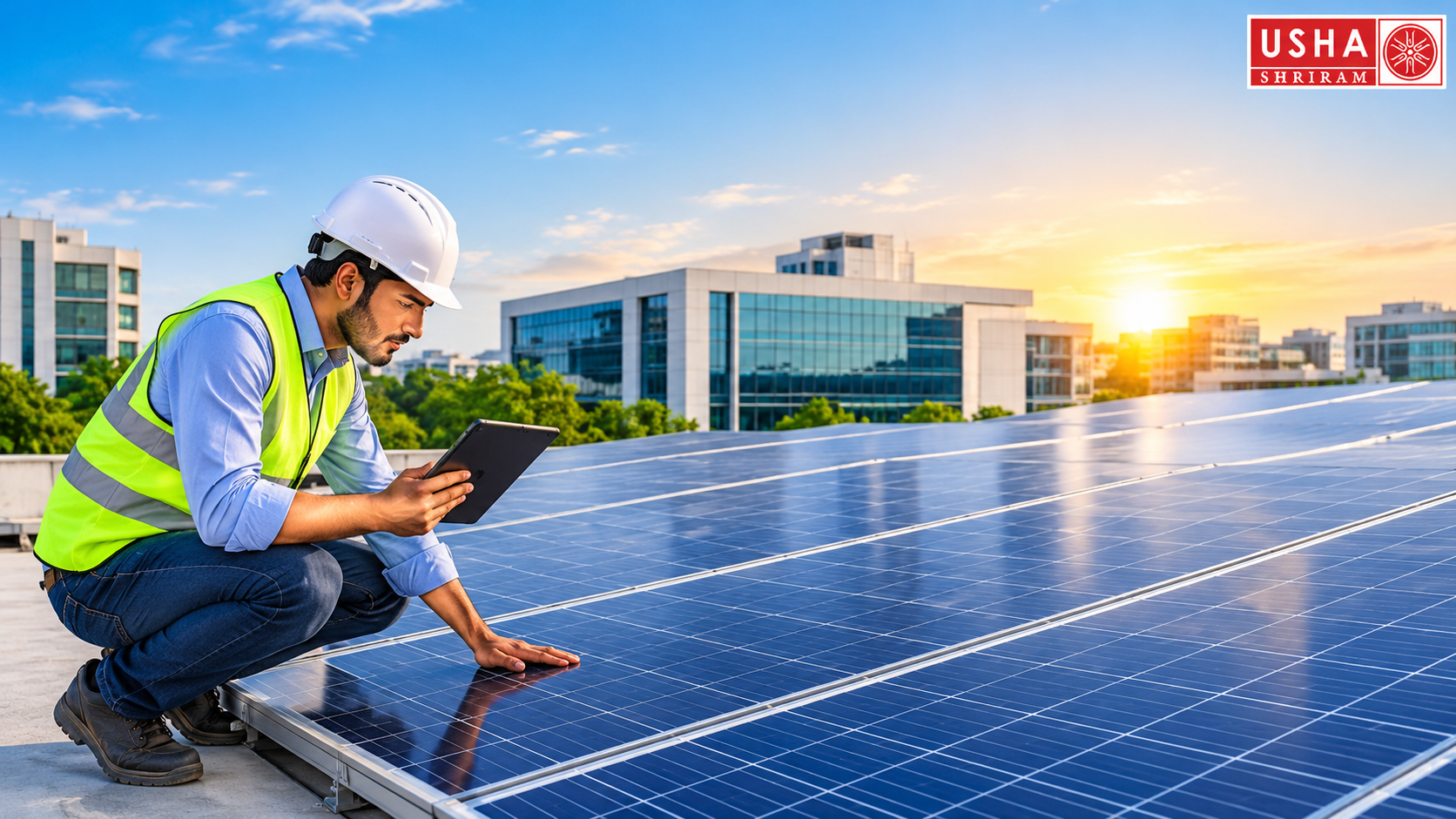
Businesses across India are increasingly exploring solar energy to support their energy requirements and sustainability goals. Choosing the right solar modules is an important part of any commercial solar project.
Several factors influence the selection of suitable solar panels for commercial use. For instance, module efficiency, wattage, cell technology, and product quality determine overall performance. Additionally, warranty coverage plays a crucial role in ensuring long-term reliability and protecting your business investment.
Usha Shriram Solar manufactures photovoltaic (PV) solar modules for residential, commercial, industrial and utility-scale applications. This guide explores the key factors businesses should consider when selecting commercial solar panels.
Why choose commercial solar systems?
Commercial solar systems involve installing a solar PV system on commercial buildings to supply energy. Most commercial systems will be connected to the grid. During daylight hours, solar energy can be used directly to power different operations within the building. As a result, businesses can reduce their dependence on grid electricity and lower overall energy costs. Moreover, when the solar system generates more electricity than the building requires, the surplus power can be exported back to the grid through net metering, subject to applicable DISCOM regulations. This allows businesses to make better use of the electricity they generate while improving energy efficiency.
Using solar energy reduces costs, protects against increasing energy prices and supports sustainable energy initiatives. As daytime energy usage in offices, factories and institutions aligns well with solar energy production, commercial solar PV systems installed on commercial building roofs can be very effective.

Solar Commercial Power Solutions
Usha Shriram Solar provide solar PV modules that can be used for commercial roof-mounted systems, industrial systems or large ground-mounted systems. To determine which module is best for your system, consider the space available (roof/land), the sanctioned load, power requirements and budget.
High-wattage modules allow for greater energy generation in a small space. This can be particularly useful for commercial buildings in urban areas. As commercial solar is a long-term investment, you should choose modules based on specifications, certification and warranty. Price should not be the main influencing factor.
How to Choose the Best Solar System Installers
With many solar providers available, it is important to find the best provider for your business based on your energy requirements, site considerations and goals. Consider the following when choosing a solar provider.
Check Experience and Track Record
Ensure the provider has experience in completing similar sized/scope projects. Request details of previous solar installations and references. Ideally, visit an active installation site.
Quality of Products and Certification
Ensure that solar modules meet technical standards required by BIS, IEC and MNRE. Inverters, cabling and racking should be from a reputable manufacturer. Carefully review the warranty information and performance warranty, including details of what is covered, conditions for warranty and the process of making claims.
Good Design
A good installation provider will carry out a detailed site survey and analysis of your energy bills to determine the best size for your system. Factors to consider include shadowing, structural integrity, orientation, load profile and potential future expansion.
Cost of Total Installation
When comparing prices, ensure that the inclusions are comparable. Include modules, inverters, racking, cabling, earthing, safety equipment, monitoring systems, installation, approvals and net-metering. Having a clear breakdown of costs will allow you to understand exactly how much is being invested and avoid unexpected extra costs.
Evaluate After-Sales Support and Maintenance
For optimal performance, solar installations should be regularly cleaned and monitored. Inquire about maintenance schedules, response times and monitoring. The best solar system installers will provide ongoing support after installation.
Commercial Solar Cost, Savings and Incentives
The cost of commercial solar will depend on the size of the system, solar module and inverter type, roof/ground conditions and location. A proper site evaluation must be carried out in order to get an accurate cost.
Savings will depend largely on the energy tariff and energy consumption. Businesses with high daytime energy consumption will commonly gain significant savings. Tax incentives may be available for commercial solar systems, such as enhanced depreciation, and incentives from State Governments. These incentives may change frequently; therefore, it is best to speak to a tax advisor and refer to official guidelines to ensure you get the best incentives for your installation.
Conclusion
Choosing the right commercial solar modules requires careful consideration of product specifications, technology, efficiency, quality and warranty.
Usha Shriram Solar manufactures photovoltaic modules for residential, commercial, industrial and utility-scale applications. Understanding module specifications and selecting products suited to project requirements can help businesses make informed solar purchasing decisions.
Explore Usha Shriram Solar’s product portfolio to learn more about its solar module offerings.
FAQ
Which businesses can install commercial solar?
Commercial solar can be beneficial to factories, warehouses, offices, hospitals, schools, hotels, malls and other commercial buildings. As long as a large proportion of energy is being used during the day, and there is space for solar to be installed, then commercial solar can be beneficial.
How can I find the best provider of commercial solar power solutions?
Look for experience in similar projects, certified products, good warranties, a good design, transparent pricing and good post-installation support. Visiting an installation site and receiving a detailed quotation are positive indicators that you have chosen a reliable provider.
What is the lifetime of a commercial solar system?
Solar modules are designed to last many years. Performance warranties tend to be long-lasting. The actual lifetime depends on module quality, installation quality, and maintenance. For specific models, refer to the warranty document.
Do commercial solar systems require maintenance?
Yes. To ensure consistent energy generation, regular cleaning, checking electrical connections, and monitoring are required.
