
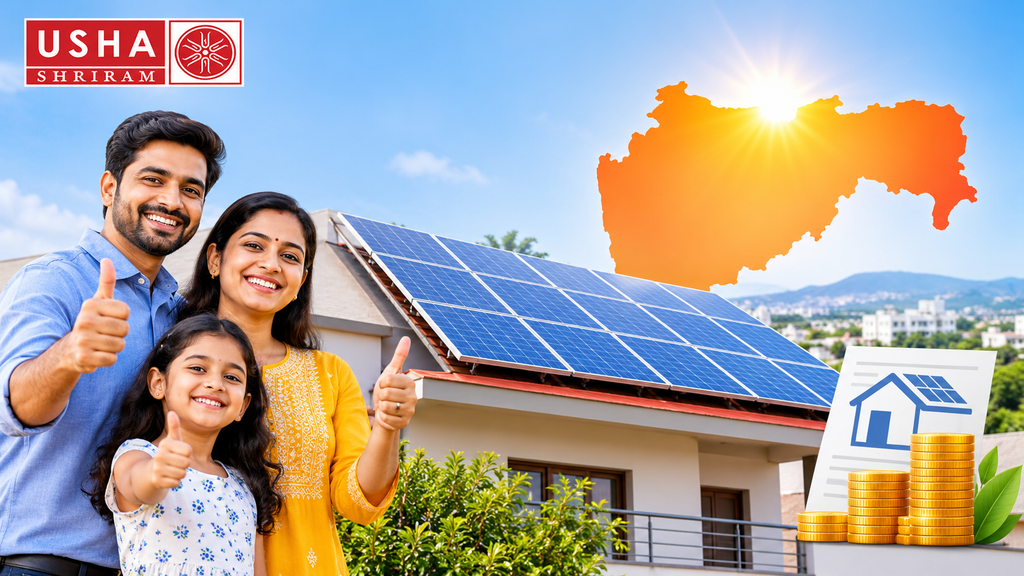
If you’re struggling with high monthly electricity bills, you may have been thinking about switching to solar energy in Maharashtra. Fortunately, there are subsidies available to support installing solar at home.
With the central Surya Ghar scheme, alongside the state SMART scheme, installing solar in your home in Maharashtra can be extremely beneficial. This guide outlines everything you need to know about the subsidy and who is eligible, as well as what installing solar involves.
Usha Shriram Solar produce PV solar panels suitable for residential, commercial, industrial and utility-scale solar. To find out more about the subsidy, please see below.
Benefits of Residential Solar in Maharashtra
Homes use many appliances, including fans, lights, fridges and TVs, and during hotter months, air conditioning too. Since most of the year in Maharashtra is sunny, residential rooftop solar can be a good fit.
Most residential rooftop systems are connected to the grid. Solar power generated during the day is used in your home first, and any excess is sent back to the grid, depending on your Distribution Company’s rules. This can significantly reduce your monthly electricity costs.
What is the SMART scheme?
The SMART scheme aims to support families in Maharashtra to install rooftop solar in their homes. Announced in October 2025, it aims to support Below Poverty Line, Scheduled Caste and Scheduled Tribe households consuming less than 100 units of electricity in a month. The scheme is being delivered by Mahavitaran (MSEDCL), and it is reported to be active until March 2027.
For eligible homes, 1kW has been installed. For these low-consuming homes, this system size is generally appropriate. On top of the central subsidy, additional state support is provided. This means that families can have rooftop solar installed at minimal cost.
How much subsidy will I get?
Under the central PM Surya Ghar scheme, eligible households can receive ₹30,000 per kW for the first 2kW and ₹18,000 for the third kW. That is up to ₹78,000 in total for a system of 3kW or larger.
Under the SMART scheme, a 1kW system costs approximately ₹50,000.
· BPL households are reported to receive ₹30,000 (central) plus ₹17,500 (state), covering approximately 95% of the cost.
· SC and ST households are reported to receive a total of ₹45,000, covering about 90% of the cost, so they pay approximately ₹5,000.
Mahavitaran has reported a reduced benchmark price of ₹45,450 per kW, so your final costs may differ.
If you don’t fall within these categories, you may still be eligible for the central subsidy. Please check the latest information on the SMART portal, Mahavitaran and pmsuryaghar.gov.in to confirm. All figures are subject to eligibility and current scheme rules.
What is Net Metering?
Net metering lets you use the solar power produced at home, with surplus energy sent to the grid. You are credited for the energy you export.
Exporting surplus energy: If your solar PV panels produce more than you use, the surplus is exported to the grid through your net meter.
Savings example: If you import 300 units in a month but export 100 units, you are billed for approximately 200 units. This example is illustrative only. Your bill will depend on the tariffs and settlement procedures set by your DISCOM.
Net metering in Maharashtra: Consumers must comply with DISCOM and state electricity regulatory requirements. For current requirements, please contact Mahavitaran (MSEDCL).
Example Savings & Payback Period
Below is an example of the expected savings and payback period for various-sized systems. Considering Central Government grants and Net Metering. Final prices will depend on the quote given, the below can be used as a guide.
2kW Domestic Solar
A 2kW system can provide a small domestic household with their daily energy requirements. With the central grant of ₹30,000 per kW, 2kW would give a total discount of ₹ 60,000, significantly reducing the cost of installation.
3kW Domestic Solar Savings
A 3kW system would be suitable for households with high energy consumption. The maximum central grant of ₹78,000 is available for this system. With net metering, this system can provide considerable savings on energy bills in the long run.
5kW Commercial Solar
A 5kW system can be installed in small businesses, including shops, clinics and offices, to reduce energy consumption and therefore reduce running costs. As this is a commercial connection, the domestic PM Surya Ghar grant will no longer apply. Tax benefits and other incentives may be available within Commercial Solar; please ensure you are aware of current regulations.
Understanding Residential Rooftop Solar Systems
A rooftop solar system turns sunlight into electricity for your home. It has four main parts:
· Solar PV modules (panels): These capture sunlight and convert it into DC electricity.
· Inverter: This converts DC electricity into AC electricity that your appliances can use.
· Mounting structure: This holds the panels securely on your roof at the right angle and direction.
· Net meter: This records the electricity you import from and export to the grid.
Most homes use a grid-connected system. Solar power generated during the day runs your appliances first, and any surplus goes to the grid, depending on your DISCOM’s rules.
How big a system do you need?
Your monthly consumption, available roof space and shading all matter. As a guide, a 1kW system generates around 120 units a month, so a home using about 100 units may be well served by 1kW, while a higher-consumption home may need 3kW or more. Actual generation varies with sunlight, orientation and weather.
For subsidy disbursement details and the latest procedures, refer to the official PM Surya Ghar portal (pmsuryaghar.gov.in) and Mahavitaran. Keep all documentation, invoices and photographs safe.
Choosing Panels and Installers
Even with subsidies, panel quality determines how much you save over 25 years or more. Here is what to look at.
Module efficiency: Efficiency shows how much sunlight a panel converts into electricity. Higher efficiency means more power from limited roof space, which suits smaller rooftops.
Wattage: Modules are rated in watts (Wp). Higher-wattage modules mean fewer panels for the same system size, so you need less roof space.
Technology: Compare cell technologies such as Mono PERC, TOPCon and bifacial modules. They differ in efficiency, low-light performance and heat tolerance.
Product quality: Check that modules meet BIS, IEC and MNRE standards. For subsidy-linked projects, confirm DCR and ALMM compliance where applicable. Also look at build quality, such as frame strength, glass and resistance to heat, humidity and dust.
Warranty: Check both the product warranty, which covers manufacturing defects, and the performance warranty, which guarantees output over time, usually 25 to 30 years. Read carefully what is and isn’t covered.
Always compare datasheets before deciding, and be cautious of offers that seem too good to be true. Regular cleaning and maintenance will also help your panels perform at their best.
Conclusion
Switching to solar is good for your household budget and for the environment. Thanks to the combination of the SMART scheme and central subsidies, families in Maharashtra can make this change at a fraction of the usual cost, subject to eligibility and current scheme rules.
Check your eligibility on the official portals, choose high-quality, certified solar modules, and confirm the latest rules with Mahavitaran and pmsuryaghar.gov.in. Get the most from the sun shining on your roof.
FAQs
1. Who can apply for the SMART scheme?
This scheme is targeted at BPL, SC and ST households consuming less than 100 units of electricity in a month. Economically weaker consumers have also been included, as announced by the state. Check the SMART portal for current eligibility.
2. Can I get a subsidy if I’m not eligible for the SMART scheme?
Yes! Eligible residential consumers can get the central subsidy (PM Surya Ghar) from a registered vendor.
3. How much electricity would a 1KW system produce?
On average, 120 units of electricity should be produced in a month. However, this amount will depend on levels of sunlight, shading, orientation and weather.
