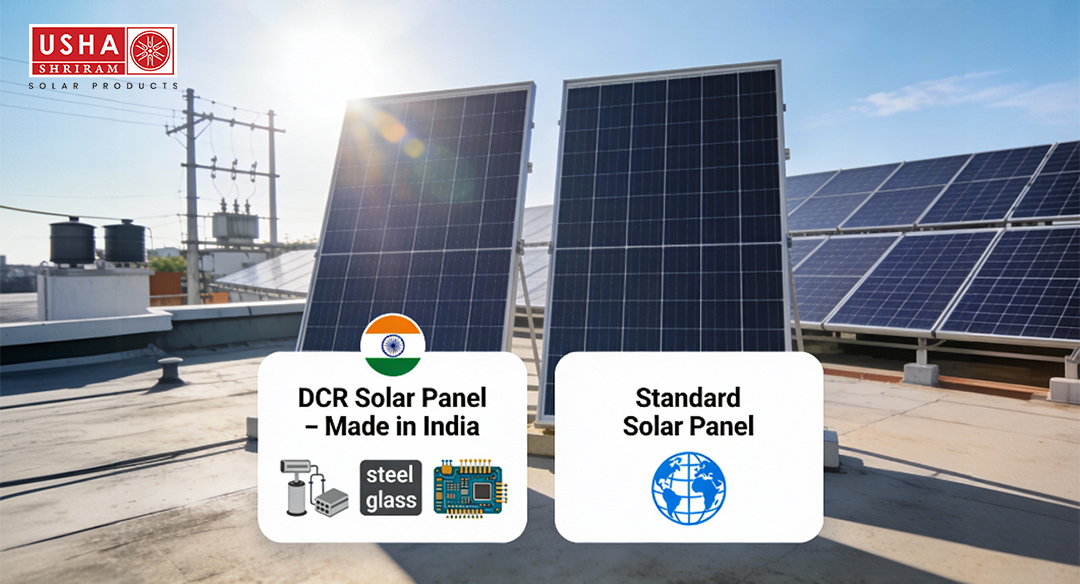
Applying for solar subsidies through the PM Surya Ghar Yojana? You’ve probably seen “DCR panels required” in the guidelines and wondered what it means. That one phrase is the source of confusion for thousands of homeowners each month. Customers would like to know what exactly a “DCR” solar panel is. Why the government requires it, and whether it will cost homeowners a lot of money.
There are some plausible answers to the above questions homeowners have, and these answers significantly impact whether homeowners lose thousands of rupees of subsidy entitlements. So, let’s get to the bottom of why and what DCR solar panels are. So, let’s clear the confusion about the DCR solar panel requirements.
What is a DCR Solar Panel?
DCR solar panel stands for the Domestic Content Requirement solar panel. Sounds technical, but the concept is straightforward.
DCR full form in solar is Domestic Content Requirement. It’s a government policy requiring solar panels installed under subsidy schemes to have certain percentages of components manufactured within India.
Regular solar panels might have cells made in China, glass from Taiwan, frames from Malaysia—then just assembled in India. DCR panel in India regulations say no. To qualify, panels must use cells and modules manufactured domestically.
The government created this policy for three reasons. First, reduce import dependence. Second, boost Indian manufacturing and create jobs. Third, ensure that subsidised money benefits the Indian economy.
For homeowners, understanding what is DCR solar panel is matters because PM Surya Ghar Yojana—offering up to 40% subsidies—mandates DCR-certified panels. Install non-DCR panels, and you forfeit government support.
Benefits of DCR Solar Panels
Beyond subsidy eligibility, DCR solar panel systems offer several advantages.
Subsidy Access: Only DCR-certified installations qualify for PM Surya Ghar benefits covering ₹30,000-78,000, depending on system size. Massive savings are unavailable with imported panels.
Quality Assurance: DCR certification requires panels meeting BIS specifications. These strict standards ensure panels handle Indian climate conditions—crucial when summer temperatures cross 45°C regularly.
Local Manufacturing Support: Buying DCR panels supports Indian manufacturers, keeping money in the domestic economy. Plus, local manufacturers provide faster warranty service.
Better Suited for India: DCR Solar Panel Manufacturers in India design products specifically for Indian conditions—monsoon humidity, dusty environments, extreme temperature variations.
DCR vs Non-DCR Solar Panels: Key Differences

Warranty Service
Non-DCR panels from overseas manufacturers create warranty nightmares. Panel fails after three years? Good luck contacting that Chinese company. DCR manufacturers with Indian presence handle claims responsively.
Manufacturing Location
DCR solar panels have their cells and modules made in India itself, while non-DCR solar panels have their components sourced from outside India, mainly from China.
Subsidy Eligibility
These panels are passed for PM Surya Ghar Subsidies. Whereas non-DCR solar panels do not qualify, even if they are of high quality.
Pricing
Dcr panels cost a little higher than non-DCR panels. However, subsidies applied to DCR solar panels make it much more affordable. For example, a ₹3 lakh DCR system with a 40% subsidy on it will cost around ₹2.2 lakhs only.
Availability
Non-DCR panels are easily available since they are cheap and can be easily imported. After the Make in India initiative, the DCR Panels’ availability has increased manifold in the market.
Is DCR Panel Subsidised with the PM Surya Ghar Yojana?
Yes. DCR panels qualify under the subsidy of PM Surya Ghar Yojana. The scheme states that every panel installed in the scheme must be DCR-certified. Here’s what PM Surya Ghar Yojana offers:
- 1kW systems: ₹30,000 subsidy
- 2kW systems: ₹60,000 subsidy
- 3kW and above: ₹78,000 subsidy
To receive this subsidy, you need your solar system to be a DCR-certified panel. If you try to get this subsidy with non-DCR solar panels, it will get rejected upfront during verification.
After proper installation of the rooftop solar system and inspections, your subsidy amount will get credited to your bank account. This verification is done before the payment, so you can’t play the system.
Some installers try to fool you by mentioning that their panel is “DCR-equivalent” or “DCR-quality” panels. You should not fall for them and ask them directly if they hold DCR-certified panels or not.
*Note: DCR requirements are only for panels; other components, like inverters and mounting structures, don’t need DCR certifications.
Get Solar Done Right
DCR solar panel requirements are very simple and meant to assist the Indian manufacturing while guaranteeing quality systems. Knowledge of what a DCR solar panel is helps you to make sound decisions and not make costly errors.
The selection of established partners such as Usha Shriram Solar will ensure smooth installations that qualify under the subsidies offered. PM Surya Ghar Yojana provides a large amount of financial funding. Do not lose these benefits by making the wrong choice of the panel. Install a certified DCR panel system and claim the amount of subsidy you deserve.
Ready to start with proper DCR certification? Call Usha Shriram Solar today to have a free site analysis and transparent quotes.
