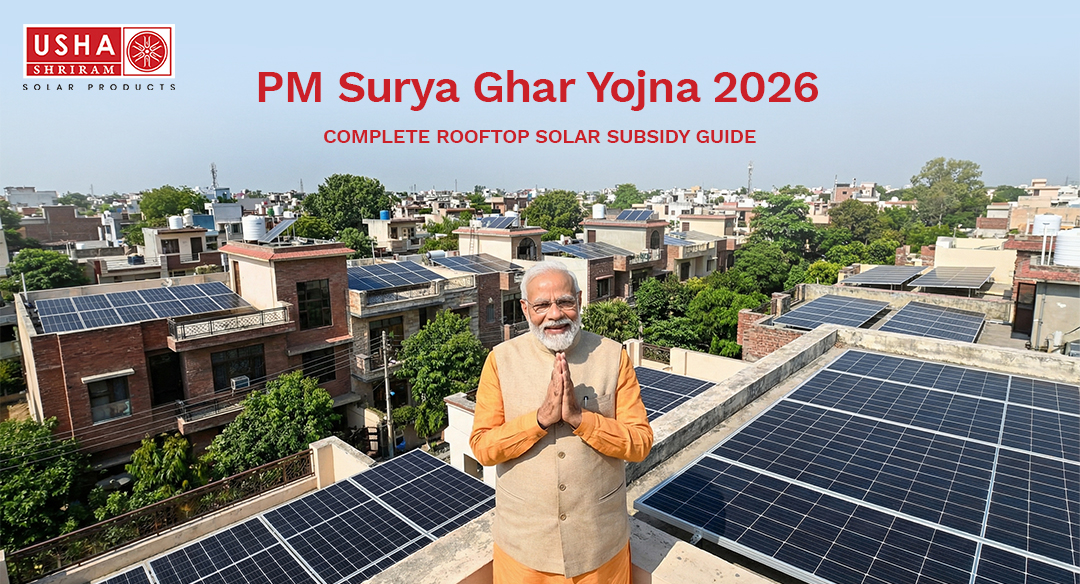
Are you paying between Rs4,000 and Rs5,000 per month for electricity? This amount could drop to zero, as well as the state will cover an enormous portion of the system that takes you there. This is the pm Surya Ghar: Muft Bijli Yojana is India’s top solar-powered subsidy program which will be in place by 2026. it will be more efficient, simple as well as more secure than before.
We at Usha Shriram Solar we’ve guided thousands of households through the exact procedure starting with finding out if they qualify to having the subsidy added to their bank accounts. This guide explains all the things that have changed, and all that hasn’t, and precisely how you can get you’re Solar panel subsidy from the government for this season.
What Is PM Surya Ghar Muft Bijli Yojana?
The program was launched in February 2024. the PM Surya Ghar is the central government’s goal to put up solar panels on rooftops of 1 million households in India. In the early 2026 period more than 30 thousand families have already made the switchand the rate is increasing as more and more people understand that the science actually is for them.
The scheme aims to:
- Lower electricity bills for everyday families
- Push India toward clean, renewable energy
- Reduce pressure on the national grid for power
- Jobs across the value chain of solar energy
- Step India closer to achieving energy independence

This isn’t just a token gesture. It’s actually a subsidy for solar energy plan that covers roughly 40-60% of the standard system’s costs – a number that changes from “someday” to “this next year.”
What’s New in 2026?
If you were interested in this plan in the past year or two and decided to pass due to delays, here’s the latest:
- Real-time application monitoring allows you to track your status at each stage of inspection and net meter installation and subsidy payment.
- A stable and functional portal -HTML0 is a stable, working portal – Aadhaar OTP logins and document uploads (PDF and JPEG) work flawlessly now unlike the rollout’s early times.
- Payouts faster in more efficient states The standard for payouts is 30 days from commissioning to having money in your bank account, and high-performing DISCOMs are currently meeting that goal regularly.
- Solar loans that are affordable Banks like SBI and PNB are now offering solar-specific loans with approximately 7% interest which means that even the post-subsidy expense doesn’t have to be paid at the start.
- Prices for panels are falling together with the subsidy, payback timeframes in the majority of cities are now between four to six years.
In a nutshell: If you’ve been waiting for your system’s maturation prior to applying, the wait is over.
How Much Solar Subsidy for Home Can You Get?
This is the one everyone would like to have first. Here’s the latest roof-subsidy solar slab structure:
- 1 system -A subsidy of Rs30,000 (ideal for homes with small spaces) that covers basic needs like lighting and fans, a refrigerator and TV)
- 2 system -Subsidy of Rs60,000 (the most sought-after option in middle class households)
- 3 kW system or greater -78,000 rupees subsidy is the maximum amount that can be accessed through the Central Scheme (even the 5 kW system is capped at 78,000 rupees)
An example: a 3kW system, which costs about Rs1,80,000 decreases to approximately Rs1,02,000 after subsidies – a simple reduction that is real and not a marketing figure.
Bonus for certain state: several states run their own top-ups on the national solar system to provide homes in India state-funded subsidies. Uttar Pradesh, for instance has a total of the equivalent of Rs30,000 over the central amount of Rs78,000, increasing the total support to $118,000. It’s important to check your particular state’s additional support before deciding on the size of your system.
Who Can Apply?
It’s been the same since its launch; however, verification is now more rigorous – so make sure you fill out your documents right the first time.
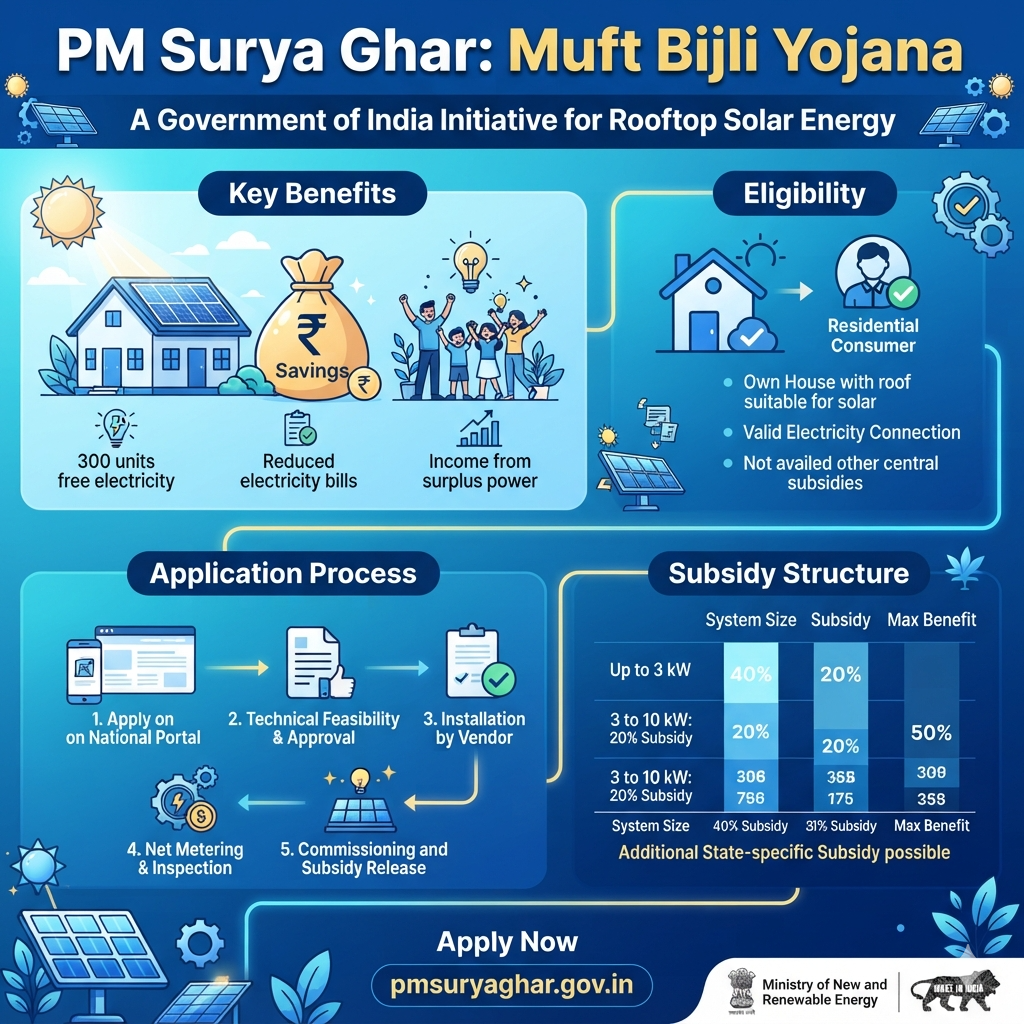
You are eligible to apply if you’re:
- A homeowner who is an individual or the owner of an apartment
- A part of an Group Housing Society applying for common-area installations
- An Residential Welfare Association applying collectively
The core requirements for HTML0:
- Indian citizen who owns residence property ownership
- An electric connection that is in your name (or the name of a family member’s)
- Rooftops with no shadows are ideal for panels
- A bank account for direct benefit transfer
- No existing solar installations that are subsidized that is connected to the same network
Who isn’t eligible: commercial properties, factories, and the government building — they are all covered under separate rules.
Important rule for 2026 to be aware of: the subsidy can be claimed once per electricity consumer number and it doesn’t change if the property is sold. Be aware of this if you’re purchasing a resales home.
Real Benefits Beyond the Subsidy Cheque
- Massive reduction in bill A 3 kW system can produce about 12-15 units per day (360-450 units per month) that cover 70 to 90 percent of households’ usage.
- Net metering revenue — power surplus that isn’t used gets sent to the grid in exchange for payments or credits. Your roof can actually earn income, not only save.
- 25plus years of almost free energy The systems usually are paid for in about 4-6 years, and leave two decades of electricity at a low cost following that.
- A higher resale value Homes with functioning solar systems generally fetch higher prices. buyers are aware of the value it offers them.
- The blackout is not a problem Grid outages and tariff increases stop being a problem for you.
- Impact on the environment A 3 kW system can cut around the equivalent of 4 tonnes CO2 each year, or equivalent to planting 180 trees.
How to Apply: Step-by-Step (2026 Process)
- Register at the official site, pmsuryaghar.gov.in, using your mobile number as well as OTP verification.
- Registration of the consumer You must enter your electricity customer number address, number, and other the basic information.
- Select the size of your system – 1 2 kW, 1 kW 3 kW or more. The website will provide the exact amount of amount of subsidy.
- Choose an empanelled vendor This is where an installer that is government-approved like Usha Shriram Solar is able to handle pricing, design and ensuring compliance.
- Feasibility test — the vendor’s visit to determine the strength of your roof, shading and design.
- Installation usually completed in a matter of days after being accepted.
- Inspection by the government -A certified engineer checks all items meet MNRE the technical requirements.
- Subsidy credit funds are directly transferred into your bank account typically after 30 days for high-performing states.
- Net Metering Setup Your vendor coordinates with DISCOM to set up the bi-directional meter, so exporting power is credited to you.
Documents that you’ll require: Aadhaar card PAN card, most recent electricity bill, proof of ownership for property or bank passbook/cancelled check address proof, photographs of passport size All of which are uploadable digitally.
In the event that your funding is deferred over 90 days following commissioning The first step is to escalate it to your DISCOM’s grievance line first, then you can call the MNRE Helpline (1800-180-3333) Then, your state’s nodal agency and lastly, CPGRAMS if not resolved.
Beyond Homes: What About Commercial Solar?
Although the PM Surya Ghar is strictly a residential project, businesses shouldn’t be excluded from India’s solar initiative. If you own a shop or warehouse, factory or office, and you want to lower operating costs and save money, choosing the top commercial solar power solutions company for your area is important exactly the same way as subsidy calculations for homeowners. Industrial and commercial solar projects require careful planning, from financing arrangements and net metering regulations to accurate payback calculations. A well-designed system from day one delivers higher ROI, better performance, and long-term savings.
Why Equipment Quality Still Decides Your Long-Term Savings
Subsidy money reduces your upfront bill. It is not a factor in how your system will perform over the course of 15 years. It all comes down to equipment. This is the place where selecting among solar producers in India is a wise decision that will pay off.
Panels must meet the strict MNRE technical specifications to be eligible for the subsidy; there’s no alternative. Beyond compliance, actual Indian conditions (heat and humidity, dust and monsoon exposure) are distinct from panels that last for 25 years, from ones that degrade after five years.
Why Choose Usha Shriram Solar for PM Surya Ghar Yojana
- Government-empanelled vendor – verified and approved to install under the PM Surya Ghar rooftop solar program.
- Support from end-to-end all the way from rooftop assessments and documents to the closing net-metering connections taken care of by one team not five.
- Fail to meet compliance requirements.
- Price transparency Each quote includes the costs for the entire system, anticipated subsidy, net investment and the payment time. No hidden charges.
- Support after installation and warranty protection and maintenance support for a long time after the system has been live.
Start Your Journey to Free Electricity
The PM Surya Ghar isn’t just a scheme; it’s actually the easiest way to a permanent reduction in electricity costs that the majority of Indian households can ever get. With subsidies that cover 40-60 percent of the installation costs and faster timeframes for disbursement and solar loans with low interest currently available, 2026 is truly one of the best years to switch to solar.
Are you ready to verify your eligibility for a subsidy? Contact Usha Shriram Solar now for an assessment of your rooftop for free and full guidance on the PM Surya Ghar Application – from paperwork to turning on the power.
Frequently Asked Questions
1. What is the PM Surya Ghar Yojana solar subsidy scheme?
Ans: It’s a Government of India initiative that provides a direct solar panel government subsidy to residential consumers who install rooftop solar systems, covering roughly 40–60% of installation cost depending on system size.
2. How much solar subsidy for home can I get under PM Surya Ghar?
Ans: ₹30,000 for a 1 kW system, ₹60,000 for a 2 kW system, and ₹78,000 for a 3 kW system or larger — ₹78,000 is the maximum central subsidy regardless of how much bigger the system gets.
3. Is there any additional solar rooftop subsidy from state governments?
Ans: Yes. Several states run their own top-up on the central scheme. Uttar Pradesh, for example, adds up to ₹30,000 extra, taking total support to ₹1,08,000. Check your state’s nodal agency for current add-ons.
4. How long does it take to receive the subsidy after installation?
Ans: The official benchmark is 30 working days from commissioning to disbursement. Well-performing DISCOMs are now hitting this consistently in 2026, though some states can still take 3–5 months.
5. Who is eligible for this solar power subsidy scheme?
Ans: Indian citizens who own residential property with an active electricity connection and shadow-free rooftop space. Individual homeowners, group housing societies, and residential welfare associations can all apply. Commercial and industrial properties are not eligible under this particular scheme.
6. Can I apply for the subsidy if my home is on rent?
Ans: No. You must own the property, or a family member on the electricity connection must be the owner. Rented properties don’t qualify under PM Surya Ghar.
7. What documents are needed to apply?
Ans: Aadhaar card, PAN card, latest electricity bill, property ownership proof, bank passbook or cancelled cheque, address proof, and passport-size photographs — all submitted digitally through the portal.
8. Can I get the subsidy more than once on the same property?
Ans: No. Each electricity consumer number can claim the subsidy only once. Selling the property to a new owner does not reset or transfer the subsidy.
9. Is financing available if I can’t pay the remaining cost upfront?
Ans:Yes. Banks including SBI and PNB now offer dedicated solar loans at around 7% interest, letting you cover the post-subsidy cost through affordable EMIs instead of paying it all upfront.
10. Does this scheme cover commercial solar installations too?
Ans: No, PM Surya Ghar is strictly residential. For businesses, working with the best commercial solar power solutions provider in your area is the better route, since commercial projects use different subsidy structures, financing, and net metering rules.
11. Why does the choice of solar manufacturer matter if the subsidy is fixed?
Ans: Because the subsidy only reduces your upfront cost — it doesn’t affect how long your system lasts. Reputable solar manufacturers in India build panels that hold up through 25+ years of Indian heat, humidity, and monsoon exposure, which is where your real long-term savings come from.
