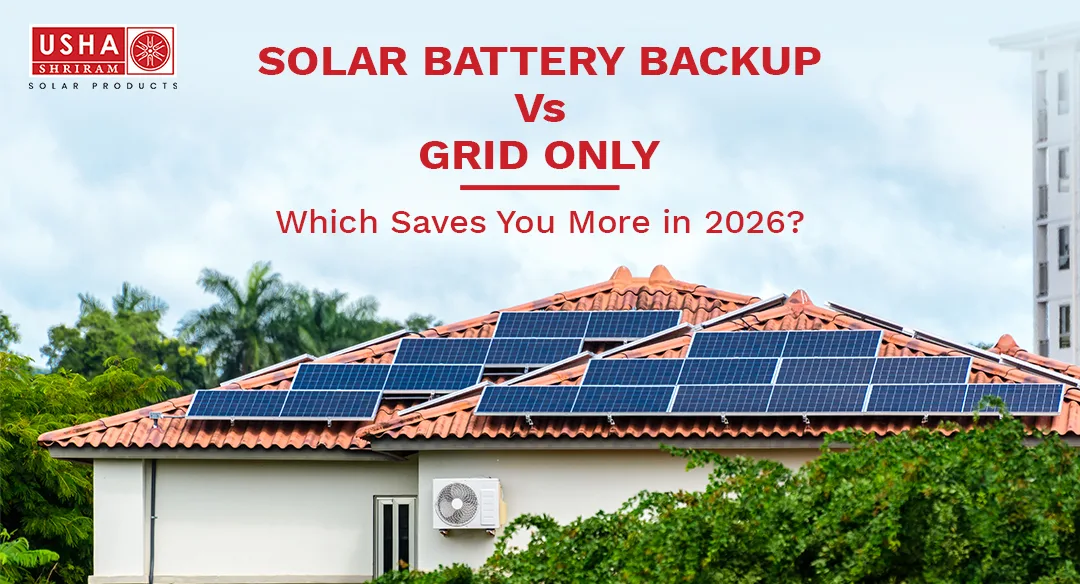
Your neighborhood experienced a six-hour power outage last week. Homes went dark, refrigerated food spoiled, and daily routines came to a halt. But one house stood out. The lights stayed on. Life continued as usual. The reason? A solar battery backup system was installed just three months ago.
This is what smart homeowners are adopting in 2026. Power outages aren’t going away, and without a solar battery backup or a grid-connected solar system, the problem remains the same every time the electricity fails.
The good news is that today’s solar technology is far more advanced than it was a few years ago. Going solar is now easier and more affordable, thanks to government-supported subsidies.
In this blog, we’ll break down solar battery backup vs grid solar systems, help you understand which option suits your needs in 2026, and show you how to save money in the long run.
Grid-Tied Solar System in India: How It Works, Benefits & Limitations
A grid-tied system consists of a connection from solar panels to the energy grid. If you produce any extra electricity, you use it immediately. The extra goes to the grids, giving you net metering credits.
How It Works
In the afternoon, on a sunny day, the panels produce around 4 kW of energy. Your house consumes only 1 kW of electricity. The additional 3 kW is supplied to the grid. Your electricity meter moves backwards. And when the evening approaches, the panels generate less energy. At that time your house consumes electricity from the grid based on your credits.
Benefits
- Less Initial Investment: The absence of batteries requires lesser initial investment
- Minimal Maintenance. There is less to fail as there are fewer components.
- Benefits to Net Metering: Surplus energy helps cover deficiencies
- Simpler Installation: Faster Setup, Fewer Approvals
Best For Whom?
Grid-tie systems are appropriate for residential consumers with stable access to electric power, favorable net metering policies, limited budgets, and non-critical power requirements running 24/7.
The Critical Fault: What happens if the grid goes down? Well, if the grid goes down, your solar panel operation will cease. The safety regulations require the shutdown at this time.
Off-Grid Solar System for Homes: Is It Worth the Cost?
Off-grid solar systems function without the electricity grid. The extra energy passes the batteries. Your house draws power from the batteries. zero connection to the grid.
How It Works
The panels produce energy throughout the day. The batteries store electricity. Your home consumes electricity from batteries every day and every night.
Advantages
- Total Independence: No grid dependence
- No Monthly Bills: Predictable, minimal power costs
- Remote Location Solution: Applies to areas whose grid connections are costly
- Immune to Grid Failures: Neighbors’ power cuts don’t affect you.
Best For Whom?
An off-grid solar system would work well in a remote area, in a location with no reliable power, or in a situation where self-sufficiency beats low cost.
The Challenge: It’s costly and needs large batteries. You need to carefully consume according to the generation and storage.
Hybrid Solar System: Best of Both Worlds
A hybrid solar system truly offers the best of both worlds. It is connected to the grid and also includes a solar battery backup for home. This setup combines a grid-connected solar system with battery storage to ensure uninterrupted power.
The solar panels first charge the batteries. Any extra energy is then sent back to the grid. If the batteries run low, electricity can be drawn from the grid. And when the grid goes down, the battery steps in to power your home.
For most residential users, hybrid solar systems are the best solar backup option in 2026.
Advantages
Continuous Power Supply:
No more disruptions during power cuts, as you have both grid and battery support.
Balanced Savings:
Net metering lowers your electricity bills, while the battery removes the need for generators.
Critical Appliance Support:
Refrigerators, medical equipment, and internet connections stay powered at all times.
Future-Proof Solution:
Protects you from increasing power outages and rising electricity tariffs.
Smart Energy Management:
The system automatically balances solar, battery, and grid usage to maximize savings.
Best For Whom?
Hybrid solar systems are ideal for homeowners who face frequent power cuts, work from home, rely on medical equipment, or want long-term savings on electricity bills.
If you’re comparing solar battery backup vs grid solar systems, a hybrid system offers the right balance, giving you the benefits of both while reducing dependence on the grid.
solar battery backup vs grid solar systems: Which Wins?
| Feature | Grid-Tied | Off-Grid | Hybrid |
| Initial Cost | ₹2.5-3L | ₹6-7L | ₹4.5-5.5L |
| Monthly Bills | Low | Zero | Minimal |
| Power During Cuts | No | Yes | Yes |
| ROI Timeline | 4-6 years | 8-10 years | 5-7 years |
| Best For 2026 | Rare cuts | Remote areas | Most homes |
The Verdict: Hybrid solar battery backup system delivers maximum value for most Indian homes—net metering savings when grid works AND backup when it doesn’t.
Choose the Right System with Usha Shriram Solar
Finding an optimal system can be done with Usha Shriram Solar by:
No-Cost Assessment for Home Energy: Usha Shriram Solar team helps you provide concrete feedback on the analysis of power cut frequency, the budget, roof space, and consumption patterns. They provide recommendations based on your data that are tailored to your requirements.
Custom System Design: They do not provide cookie-cutter solutions. They offer a solar system solution that is appropriately sized for you: the panel capacity is tailored to you, the battery storage is right, and the inverter is selected optimally.
Unambiguous ROI: With these providers, you receive ROI showing when investment pays for itself and 25-year savings potential.
Financing Flexibility: Multiple payment plans making solar backup for home accessible within your budget.
Solar Energy Storage Costs in 2026
Solar battery backup savings have improved dramatically. Battery prices dropped 40% since 2021.
Current Pricing (5kW systems after subsidies):
- Grid-Tied: ₹2.5-3 lakhs
- Hybrid with 5kWh battery: ₹4.5-5.5 lakhs
- Off-Grid with 10kWh battery: ₹6-7 lakhs
Yes, hybrid costs more initially. But eliminating generator fuel (₹3,000-5,000 monthly), avoiding inverter battery replacements (₹15,000-20,000 every 3 years), and reducing electricity bills 80-90% means better returns.
Most homeowners recover costs within 5-7 years, then enjoy virtually free electricity for 18+ additional years.
What Usha Shriram Solar Actually Provides?

This is important to clarify.
Usha Shriram Solar specializes in:
- High-quality solar panels
- Reliable on-grid inverters
- Grid-connected solar system solutions
Their focus is on helping homeowners get the maximum benefit from grid-tied solar, where most savings are generated.
How Usha Shriram Solar Helps You Save More
Usha Shriram Solar supports customers by delivering strong, efficient, and reliable grid-connected systems.
Here’s how they add value:
- High-Efficiency Panels: Designed for consistent generation and long life
- Reliable On-Grid Inverters: Optimized for net metering and grid stability
- Professional Installation Support: Ensures proper system performance
- Net Metering & Documentation Guidance: Smooth approval process
- Performance Transparency: Clear generation and savings visibility
Their role is to ensure your solar system performs exactly as expected, year after year.
Make the Smart Choice Today
The debate between solar battery backup vs grid has a clear winner for 2026: a hybrid system. It is leading for most Indian homeowners because it will provide:
- Maximum bill savings via net metering
- Power during cuts without interruption
- Energy security against future uncertainty
- Best 25-year ROI
Grid-tied works only with rock-solid reliability are very less common. Off-grid serves remote locations only. Ready to calculate your exact savings?
Contact Usha Shriram Solar for a free home energy assessment today. Their experts will:
- Analyze your individual consumption
- Estimate potential savings with various systems
- Provide transparent pricing and projections for return on investment.
- Help Choose the Best Solar Backup Option 2026
Stop waiting for the next power cut; be responsible and join the thousands that enjoy an uninterrupted power cut with huge savings.
Call Usha Shriram Solar now or visit their website for a quick consultation. A single conversation can mark the beginning of living independently with energy.
Get Your Free Solar Assessment Today → contact
What is the best solar backup option in 2026 for homes?
For most homes, a hybrid system is the best solar backup option in 2026 as it combines savings and backup.
Can solar backup for home run during a power outage?
Yes, a solar backup for home with batteries continues supplying power even when the grid fails.
How much can I save with a solar battery backup system?
Solar battery backup savings can reduce electricity bills by up to 80–90% over time.
Does a grid-tied solar system work during power cuts?
No, in a grid-tied setup, solar panels shut down during outages for safety reasons.
