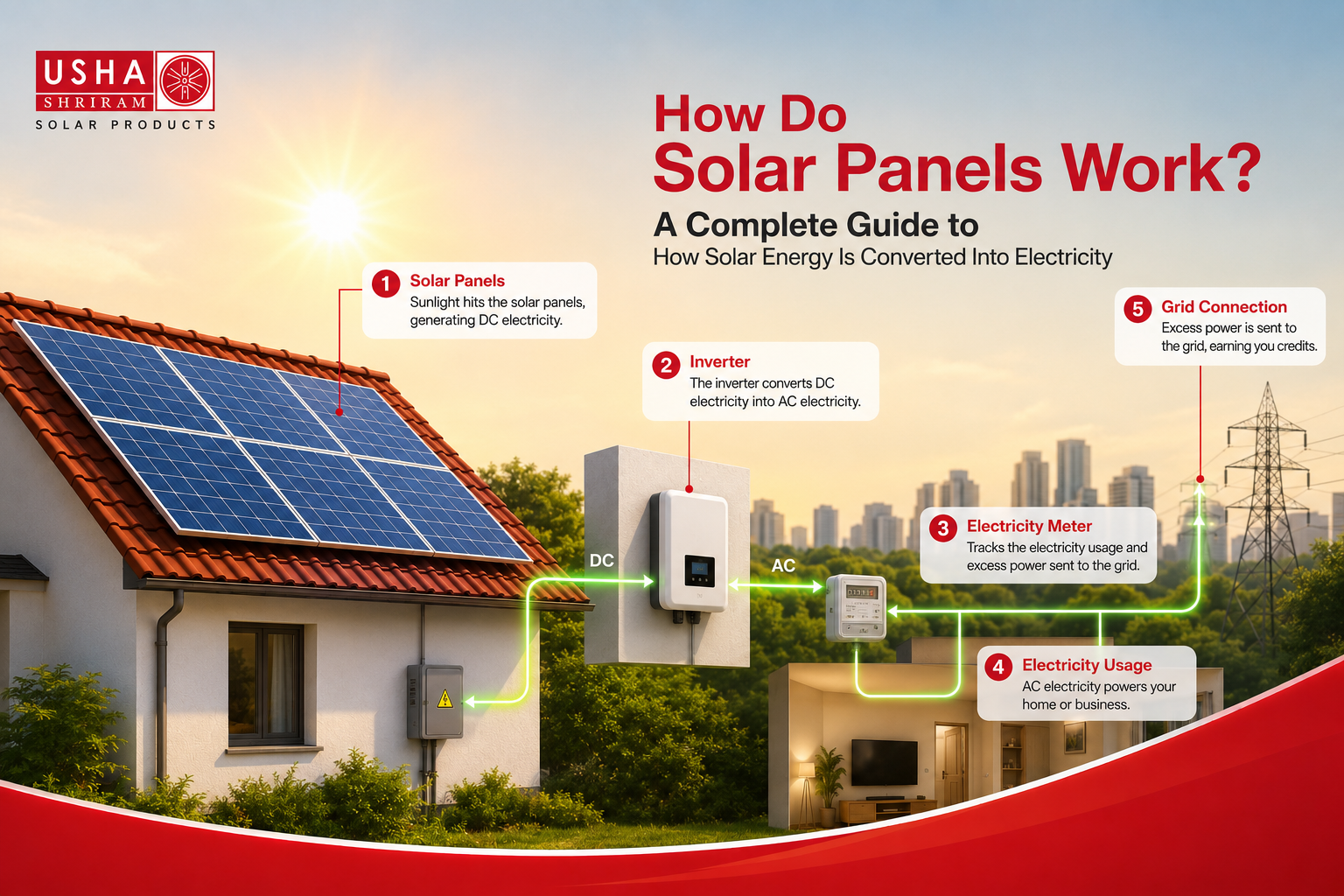
You have seen them on rooftops, in fields and more and more on factory sheds across India. They are dark blue or black panels sitting quietly under the sun. Have you ever stopped to wonder what is actually happening inside them? There is no motion, no smoke and no sound. Yet somehow sunlight becomes electricity that can run your fridge, your fan or even an entire factory floor.
This guide answers the three questions people ask most: how solar panels work, how they generate electricity, and how solar energy becomes usable electricity. As we go, we will also talk about what to look for when choosing panels and installers. This is useful whether you are a homeowner in Lucknow or a business looking for a power plant for commercial use.
How Do Solar Panels Work?
At a basic level, a solar panel is a device that catches sunlight and turns it into electricity that your home or business can actually use. This happens through something called the photovoltaic effect. People discovered this over a hundred years ago. It only became practical to use in business after decades of work in science.
A solar panel is not one single part. It is a group of smaller parts working together:
• Solar cells: These are the building blocks of a panel. Most solar panels use silicon, which reacts to sunlight.
• Glass layer: A protective cover that lets sunlight in while keeping the cells safe from weather and dirt.
• Encapsulant (EVA layer): A material that sticks the cells to the glass and the back layer to keep moisture out.
• Backsheet: The layer that provides insulation and keeps out the weather.
• Frame: Usually made from aluminium, it strengthens the panel and supports secure mounting.
• Junction box: This is where the electrical output of the panel connects to the wires that carry the electricity away.
A solar panel connects many cells, while multiple panels connect to create a solar array. This array is the system you see on a rooftop or a piece of land.
How Solar Panels Generate Electricity: The Step-by-Step Process
This is where the real science happens. Knowing this process makes it much easier to check the quality of a panel, decide how big your system should be, and understand why certain weather affects how much power you get.
Step 1: Sunlight Strikes the Solar Cell
Each solar cell uses silicon mixed with small amounts of other elements. This process, known as doping, improves the silicon’s ability to conduct electricity. It creates two layers inside the cell: one with extra electrons (the negative layer) and one with fewer electrons (the positive layer). Where these layers meet is called the p-n junction. It is the heart of how the whole system works.
Step 2: Photons Knock Electrons Loose
Sunlight is made of energy packets called photons. When photons hit the silicon cell with enough energy, they knock electrons loose from their bonds. This is the effect in action. Light energy directly moves electrons, creating an electric current.
Step 3: The Electric Field Directs Electron Flow
The p-n junction inside the cell creates a built-in field. This field pushes the freed electrons in one direction. It forces them to flow through a circuit instead of just moving around randomly inside the cell. This steady flow of electrons is what creates DC electricity.
Step 4: Electricity Flows to the Inverter
Solar panels produce DC electricity, but most home appliances and the power grid use AC electricity. Most things run on alternating current (AC). This is why you need an inverter. An inverter is an important piece of gear that turns DC into AC power that works with the grid. Without an inverter, the electricity from a panel array would have nowhere useful to go.
Step 5: Power Is Used, Stored or Exported
Once the electricity is turned into AC, it can do one of three things depending on how your system’s set up:
1. Power your lights, appliances or machines directly as you use them.
2. Charge a battery in hybrid or off-grid systems so you can use power after the sun goes down or during a power cut.
3. Flow back into the grid through a metering setup in on-grid systems. This basically lets you “bank” the electricity you make.
How Is Solar Energy Converted Into Electricity? A Deeper Look at Efficiency
It is important to know that not all sunlight hitting a panel becomes electricity. Some of it is lost to reflection, heat and internal resistance. The amount of sunlight a panel successfully turns into electricity is called its conversion efficiency. This number is very important because it tells you how many solar panels you will need to get the power you want.
A few things change how well solar energy is converted into electricity:
• Cell technology: Monocrystalline cells are made from one silicon crystal. They usually convert sunlight more efficiently than older polycrystalline cells made from many silicon pieces.
• Temperature: This might sound strange. Solar panels can lose some efficiency when it gets extremely hot. This is measured by a temperature coefficient. It is a detail you should ask about, especially if you are installing them in parts of India.
• Orientation: Panels that face the sun directly for most of the day will make more electricity than panels placed at a bad angle or in the shade.
• Dirt: A layer of dust on the solar panel surface blocks light from reaching the cells. This is why cleaning them regularly is part of maintenance.
• Panel wattage rating: Higher-wattage panels make more power per panel. This affects how many panels you need to reach your goal.
Types of Solar Cell Technology You’ll Encounter
When you look at your options, you will see a few types of cells. Each one has costs and efficiency levels:
• Monocrystalline (Mono PERC) cells: These are made from a single silicon crystal. They have a layer on the back that reflects unused light into the cell so it can try to convert it again. These are very common in homes and businesses.
• Polycrystalline cells: Made from multiple silicon crystals. They were widely used in earlier generations of solar panels but generally have lower efficiency than modern monocrystalline technologies.
• Thin-film cells: Made by depositing photovoltaic material onto a supporting surface. They can be lightweight and flexible, making them suitable for certain applications where conventional crystalline silicon panels may not be ideal.
Also, I would not say “mono PERC is the standard choice” unless you specifically want to promote that technology. Solar technology is evolving, so keep this section technology-neutral.
How Much Power Does a Solar Panel Actually Produce?
A panel’s wattage rating indicates its power output under standard test conditions. However, the actual electricity generated depends on factors such as sunlight availability, temperature, orientation, shading, system losses and panel efficiency.
Higher-wattage panels can be useful where roof space is limited because fewer panels may be required to achieve a particular system capacity. If you are planning a rooftop or a small business setup, price is a big question. The price of a 500 W solar system in India changes based on the type of panel, the brand of the inverter, the mounting parts, and how hard it is to install. It is better to look at it as a starting point than a set price. Getting a quote for your site will give you a much better idea of the cost.
Choosing the Right Panels and Installer
Knowing how solar panels work is half the job. Choosing the gear and the right person to install it is what actually leads to real savings.
What to Look for in a Panel
When you compare the solar panels in India, do not just look at the price. Look at the cell technology, the efficiency rating, the temperature coefficient and the history of the company that makes them. Many people looking for solar panel brands in India find that companies that test their own products tend to have better quality.
Finding an Installer Near You
The quality of a solar installation can change a lot depending on where you live and who you hire. Because of this, many people search for experts. Finding the Right Solar Installer
Choose an installer based on their technical expertise, project experience, installation quality, after-sales service, warranty support and ability to handle approvals and metering requirements. Whichever way you go, you should make a list of the solar system installation companies in your area and ask them specific questions. What kind of cell technology do they use? How long does it take to install? Do they help with the metering paperwork? How do they help if there is a problem after the job is done?
For businesses looking for solar energy in India, providers for large projects, Usha Shriram Solar is a name that comes up. They take an approach by handling everything from checking the site and designing the system to picking the panels and installing them. They do more than just sell equipment. Leave the work to us.
Why Understanding Solar Technology Matters for Businesses
If you are looking at panels for commercial use, knowing how the conversion works helps you ask better questions. For commercial and industrial installations, panel efficiency is only one part of overall system performance. Roof orientation, shading, panel layout, temperature, inverter selection, cable routing and system design can all influence electricity generation.
A professional site assessment helps businesses determine the appropriate system capacity and configuration based on their electricity consumption and available installation area.
Frequently Asked Questions
Q1. Do solar panels work without sunlight?
Yes, solar panels can still make electricity in hazy light. However, they will not make as much power as they do under a clear sunny sky. This is why we usually plan systems based on the amount of sunlight in a year rather than just the brightest days.
Q2. What is the difference between DC and AC electricity in a system?
Solar panels generate DC (direct current) electricity, and DC (direct current) electricity flows in only one direction. Most appliances and the electrical grid use AC (alternating current), so you will need an inverter to turn DC (direct current) electricity into AC (alternating current). An inverter is a must for every power system.
Q3. How long do solar panels typically last?
Most solar panels are built to make electricity for 25 years or even more. However, the amount of electricity panels make will slowly go down as time passes. This slow drop is what manufacturers call the degradation rate.
Q4. Does panel wattage alone tell me how much electricity I will get?
Not really. Wattage tells you how much power a panel makes during a test, but how much electricity you actually get depends on many things. You have to think about how much sunlight your area gets, where the solar panels face, if there is shade, the heat and any system losses.
Q5. Is a higher-wattage panel the better choice?
Not always. High-wattage panels like 585W options can help if you do not have space on your roof because you will need fewer solar panels. The best choice for you depends on your budget, your roof layout and whether the panels work with your inverter. It is always best to talk to your installer to be sure.
Final Thoughts
Solar panels might look very simple when you look at them. There is a lot going on to power your home or business. It takes a lot of work, with science and engineering, to make it work. When you understand how sunlight turns into electricity—from the cells making power to the inverter changing DC (direct current) into AC (alternating current)—you can pick the best solar panels and system size. You will feel more sure of yourself when you listen to what vendors tell you.
If you are ready to see what solar panels can do for your roof or your business, Usha Shriram Solar can help with your site assessment, picking the solar panels and designing a system that fits how much electricity you use and where you live.
